
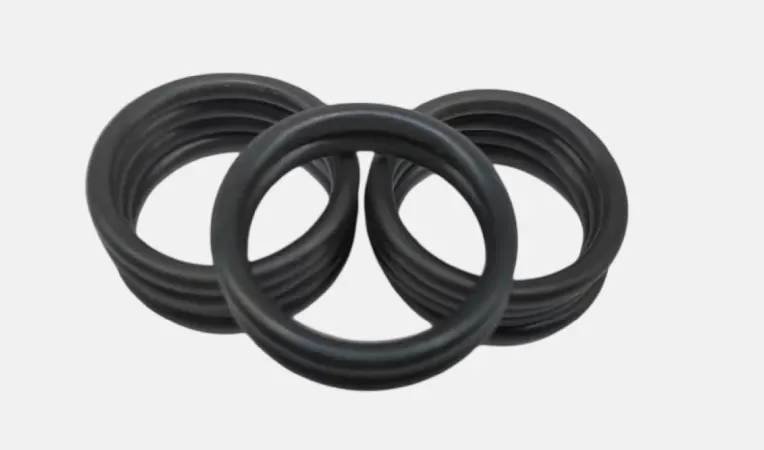
Natural Rubber O-Rings
Natural Rubber O-rings are flexible elastomeric seals that prevent fluid and gas leakage between mating surfaces in static and dynamic applications.
Rubber Xpert Inc. is based in the USA, manufactures NR O-rings with high elasticity, and is made for industrial, automotive, and OEM applications in North America. It covers different grades, specifications, application suitability, selection guidelines, and bulk sourcing from a verified US manufacturer.
Buy Natural Rubber O-Rings in Bulk from a Trusted Manufacturer
& Supplier, Rubber Xpert Inc.
Rubber Xpert Inc. manufactures natural rubber O-rings to OEM and industrial specifications, with batching, dimensional tolerances, and custom sizing available in AS568 and non-standard cross-sections.
Bulk orders are supported by high-volume molding capacity, material certifications, and full QC inspection before shipment. Rubber Xpert Inc. delivers verified NR compound quality for procurement teams sourcing a rubber O-rings, bulk pricing, and specification-to-delivery support.
Silicone O-Rings
Wide-temperature sealing for static environments where purity matters.
RING
01
EPDM O-Rings
Built tough for outdoor and water-based environments with excellent weathering and steam resistance.
RING
02
Neoprene O-Rings
A well-rounded performer offering sealing in chemicals, weather, and moderate heat.
RING
03
Fluorosilicone O-Rings
Fuel and oil resistance without sacrificing low-temperature flexibility, ideal for aerospace and automotive static seals.
RING
04
HNBR O-Rings
Upgraded nitrile performance that handles higher heat, tougher chemicals, and heavy wear for dynamic applications.
RING
05
Buna (NBR) O-Rings
The industry's go-to general-purpose seal, cost-effective, and proven in oil and fuel environments.
RING
06
Polyurethane O-Rings
Tough sealing for high-pressure and dynamic applications where wear resistance and load-bearing strength are critical.
RING
07
Santoprene O-Rings
Recyclable thermoplastic elastomer built for seals in weather-exposed environments.
RING
08
Butyl Rubber O-Rings
The top choice where gas impermeability is non-negotiable, with solid resistance to heat, acids, and weathering.
RING
09
AEM O-Rings
A premium underhood elastomer engineered for sustained sealing performance in extreme heat, hot oils, and harsh automotive environments.
RING
10
Why Buy Natural Rubber O-Rings from Rubber Xpert Inc.?
The reasons to buy Natural Rubber O-Rings from Rubber Xpert Inc. are listed below.
- Custom Manufacturing: O-rings are produced to geometries, including non-standard diameters and cross-sections.
- Material Selection: NR compound and durometer grade are matched to the elasticity, tear strength, and temperature demands.
- Dimensional Accuracy: Every O-ring is held to tight tolerances, ensuring consistent groove fit and reliable compression sealing.
- Quality Control: Each batch undergoes hardness, tensile, and dimensional inspection before shipment.
- Bulk Production: High-volume orders are fulfilled with consistent batching and mold-to-mold repeatability.
- Specification-to-Delivery Support: Technical assistance covers material selection, drawing review, prototype approval, and final delivery.
What Are Natural Rubber O-Rings?
Natural Rubber O-rings are loop-shaped seals made from NR compound that sit inside a groove and block fluid or gas leakage when compressed between two mating surfaces. The circular cross-section deforms under squeeze, pressing against the groove walls to form a seal that tightens as system pressure increases.
Natural Rubber offers high elasticity, tear strength, and rebound but is not suitable for ozone, UV, or petroleum-based fluid exposure above 80°C.
What Materials and Natural Rubber (NR) Compounds Are Used to
Manufacture Natural Rubber O-Rings?
Warning: Undefined array key "rubber_product_material_main_desc" in /home/u221192900/domains/rubberxperts.com/public_html/wp-content/themes/rubberexperts/templates/sub-product-details-template-new.php on line 374
Natural Rubber O-rings are made from NR compound sourced from Hevea brasiliensis tree latex, vulcanized with sulfur-based or peroxide curing systems to achieve durometer grades ranging from 30 to 90 Shore A. General-purpose grades cover standard mechanical and agricultural applications, while carbon black-filled compounds improve tear and abrasion resistance for heavy-duty use.
Food-contact and medical grades use FDA 21 CFR-compliant compounding without harmful plasticizers, but NR has no high-temperature materials for manufacturing grades and is generally replaced by synthetic elastomers above 80°C.
Natural Rubber O-Rings Material Comparison Table
Natural rubber O-rings material comparison is shown in the table below.
| Material / Compound | Temperature Range | Flexibility | Chemical Resistance | Regulatory Suitability | Typical Applications | Key Limitations |
|---|---|---|---|---|---|---|
| NR General Purpose | -50°C to +80°C | Excellent | Resistant to water, alcohols, mild acids. Poor vs. oils and ozone | Not FDA/medical compliant | Shock mounts, mechanical fasteners, vibration dampeners | Degrades in UV, ozone, and petroleum-based fluids |
| NR Carbon Black-Filled | -50°C to +80°C | Good to Excellent | Same as general purpose. Improved abrasion resistance | Not FDA/medical compliant | Agricultural equipment, heavy-duty mechanical seals | Higher hardness reduces flexibility at low temps |
| NR Sulfur-Cured (30-50 Shore A) | -50°C to +70°C | Very High | Water, dilute acids, mild alkalis | Not FDA/medical compliant | Soft seals, low-pressure static joints, flexible couplings | Very low resistance to heat aging and ozone |
| NR Sulfur-Cured (60-90 Shore A) | -50°C to +80°C | Moderate | Water, alcohols, mild chemicals | Not FDA/medical compliant | High-pressure static seals, structural mounts | Brittle at temperature extremes. No oil resistance |
| NR Peroxide-Cured | -50°C to +90°C | Good | Slightly broader chemical resistance than sulfur-cured grades | Not FDA/medical compliant | Dynamic seals, reciprocating applications | Lower elongation than sulfur-cured. Still ozone-sensitive |
| NR FDA-Compliant Grade | -50°C to +80°C | Good to Excellent | Water, food-contact fluids, dilute acids | FDA 21 CFR 177.2600 | Food processing seals, beverage equipment gaskets | No resistance to oils, fats, or cleaning solvents |
| NR Medical-Grade | -50°C to +70°C | Excellent | Aqueous media, saline solutions | USP Class VI, ISO 10993 (latex-specific testing required) | Syringe components, medical device seals | Latex allergen risk. Not suitable for latex-sensitive patients |
How to Choose the Right Natural Rubber O-Ring for Your Needs?
Choosing a natural rubber O-ring means confirming the NR compound, dimensional spec, and operating limits match your actual application conditions before ordering.
To choose the right natural rubber O-ring for your needs, follow the eight steps below.
- Size and Cross-Section: Measure the inner diameter, outer diameter, and cross-section against your dimensions, as an incorrect fit causes extrusion or accelerated wear.
- Hardness and Durometer Grade: Select 30 to 50 Shore A for low-pressure or soft-seal applications and 60 to 90 Shore A for high-pressure static joints.
- Temperature Range: Confirm temperature stays within -50°C to +80°C, as sustained exposure above 80°C causes permanent hardening and seal failure.
- Pressure Rating: Use higher durometer grades for higher system pressure, and add a PTFE backup ring when pressure exceeds the groove design limits.
- Media Compatibility: NR performs well with water, alcohols, dilute acids, and mild alkalis but degrades in petroleum oils, fuels, ozone, and UV-exposed environments.
- Compression Set: Choose peroxide-cured NR for long-term static applications, as sulfur-cured grades recover less after prolonged deflection.
- Regulatory Requirements: Specify FDA 21 CFR 177.2600 for food contact, USP Class VI or ISO 10993 for medical devices, and confirm latex allergen documentation when patient contact is involved.
- Operating Environment: Replace NR with EPDM or Neoprene for outdoor or ozone-rich settings, NBR or HNBR for petroleum fluid systems, and silicone or FKM for temperatures above 80°C.
Where Are Natural Rubber O-Rings Commonly Used?
Natural rubber O-rings serve industries where dynamic flexing, vibration, and shock loads compromise standard elastomer seals.
The industries that depend on natural rubber O-rings are outlined below.
Industrial Machinery
Seals machinery components under vibration and shock loads, using elastic recovery to industrial and machinery maintain contact pressure.
Hydraulic & Pneumatic Equipment
Handles low-pressure air systems and non-oil-based fluid lines where NR flexibility absorbs pressure cycling without permanent deformation.
Agricultural Equipment
Withstands abrasive dust, repeated impact, and continuous flexing in irrigation and field equipment sealing points.
Construction Equipment
High tear strength and shock absorption hold up under heavy intermittent loading and ground vibration on job sites.
Automotive Components
Used at non-fuel, non-oil contact points in suspension and isolation systems where rebound resilience is the automotive industry's primary requirement.
Material Handling Equipment
Maintains seal integrity in high cycle counts and variable load conditions in conveyor and repetitive-motion mechanisms.
General Manufacturing
Natural rubber O-rings consolidate the sealing roles covered in material handling equipment, specifying cost-efficient, low-chemical-exposure gasket needs.

Frequently Asked Questions About
Natural Rubber O-Rings
Common questions about natural rubber O-ring properties and applications help buyers select the right seal for their system.
Natural rubber O-rings are seals manufactured from NR latex, with sulfur curatives and fillers. The material key properties include tensile strength, tear resistance, and elastic recovery in a Shore A durometer range of thirty to ninety.
The operational temperature range for natural rubber O-rings is -65°F to 180°F. It allows heat to accelerate oxidation past the upper limit, and cold reduces elasticity below the lower threshold.
The main advantages of using natural rubber O-rings over synthetic rubber are tear resistance, and elastic recovery under dynamic load. Cost efficiency and strong abrasion resistance support natural rubber as a practical choice for oil-free sealing systems.
The chemical, water, and environmental resistance natural rubber O-rings offer includes water resistance, limited chemical resistance, and moderate ozone protection. Petroleum oils, fuels, and solvents cause swelling and degrade the seal over time.
You should avoid using natural rubber O-rings when systems involve petroleum-based oils, fuels, or aggressive solvents, because the fluids cause swelling and premature seal failure.
High-temperature environments exceeding 180°F accelerate polymer breakdown, and prolonged sunlight or ozone exposure favors alternative compounds (EPDM) instead.
The common industries and dynamic sealing applications for natural rubber O-rings are industrial machinery, agricultural equipment, and construction machinery, where vibration and shock loads require elastic recovery.
Natural rubber O-rings deliver Synthetic Isoprene (IR) matches the properties with tighter batch consistency, and EPDM O-rings trail in elasticity but lead in ozone and weather resistance.
Procurement teams select IR for supply consistency and EPDM for long-term outdoor sealing.
Yes, natural rubber O-rings suit high-wear and high-impact sealing applications, given the strong abrasion resistance. The performance holds within the recommended temperature range, provided the system avoids oil or fuel contact.
Need Custom O-Rings for Your Application?
Tell us your size, material, quantity or application requirements and our team will provide a competitive quote.
Materials
Manufacturing
& Fast Response
You can upload it with your enquiry.