
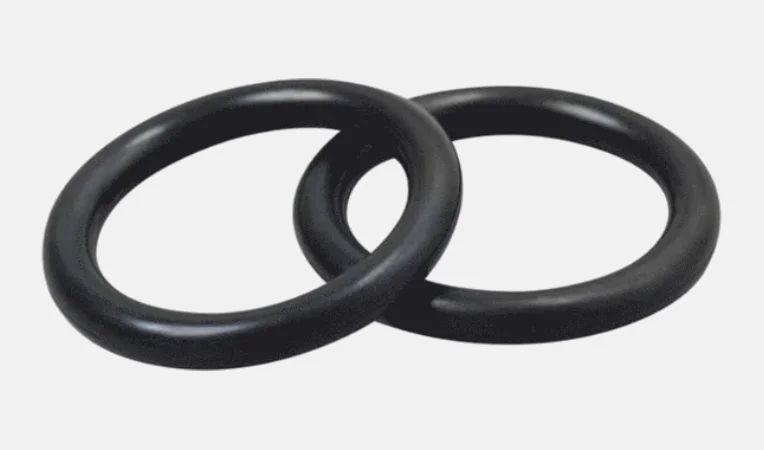
Buna (NBR) O-Rings
Buna (NBR) O-rings are sealing components used to prevent leakage between mating surfaces, built from an acrylonitrile-butadiene elastomer to withstand petroleum exposure, which causes seal failure in industrial and automotive systems.
Rubber Xpert Inc. manufactures Buna (NBR) O-rings for OEM buyers and procurement teams in the USA. This guide covers what Buna (NBR) is made of, where it performs best, and how to specify the right compound for your application.
Buy Buna (NBR) O-Rings in Bulk from a Trusted Manufacturer
Supplier, Rubber Xpert Inc.
Rubber Xpert Inc. delivers Buna (NBR) O-rings for bulk orders and custom project specs. Each ring comes from premium nitrile compounds built to resist oil, fuel, and hydraulic fluids without compromising seal integrity.
Our production line balances your volume needs, from standard AS568 sizes to fully custom dimensions for OEM and industrial builds, backed by our full catalog of rubber O-rings.
Silicone O-Rings
Flexible, high-purity sealing built for extreme temperature swings in food-grade, medical, and outdoor equipment.
RING
01
EPDM O-Rings
Reliable water and steam sealing built to hold up against weathering, sunlight, and outdoor exposure.
RING
02
Neoprene O-Rings
Balanced chemical and flame resistance suited for refrigeration lines and marine hardware exposed to the elements.
RING
03
Fluorosilicone O-Rings
Fuel and oil-resistant sealing engineered for aerospace and automotive systems operating across wide temperature extremes.
RING
04
HNBR O-Rings
Tough, abrasion-resistant sealing for continuous mechanical wear in oil-field drilling and refrigerant environments.
RING
05
Polyurethane O-Rings
High-strength sealing built for dynamic loads and heavy abrasion in hydraulic and pneumatic assemblies.
RING
06
Santoprene O-Rings
Flexible, PVC-free sealing engineered for wide temperature swings in food, beverage, and outdoor equipment.
RING
07
Butyl Rubber O-Rings
Low-permeability sealing suited for high-vacuum chambers and pressurized gas systems.
RING
08
Natural Rubber O-Rings
High-resilience sealing with strong abrasion resistance for general-purpose mechanical and vibration applications.
RING
09
AEM O-Rings
Heat and hot-oil resistant sealing built for demanding automotive drivetrain and transmission environments.
RING
10
Why Buy Buna (NBR) O-Rings from Rubber Xpert Inc.?
Rubber Xpert Inc.'s value propositions are listed below.
- Custom Compound Formulation: Engineers adjust acrylonitrile content to match each client’s oil and fuel resistance needs.
- Material Grade Selection: Our technicians assign NBR compound grades per ASTM D2000 classification standards.
- Dimensional Tolerance Control: Molding holds tight tolerances aligned with AS568 sizing standards.
- In-Process Quality Inspection: The quality teams run durometer and dimensional checks under ISO 9001-aligned procedures.
- High-Volume Production Capacity: Manufacturing lines scale output for bulk orders without comprising batch consistency.
- Specification-to-Delivery Support: Account engineers manage the process from spec to shipment by providing RoHS and REACH documentation.
What Are Buna (NBR) O-Rings?
Buna (NBR) O-rings are circular sealing components with a round cross-section that compress inside a groove to block the escape of fluid or gas between two mating surfaces. The elastomer’s elasticity lets it conform to the groove profile and maintain constant sealing force even under mechanical vibration or pressure fluctuation.
NBR offers strong resistance to petroleum oils and hydraulic fluids but degrades under ozone, UV exposure, and prolonged sunlight.
What Materials and Buna (NBR) Compounds Are Used to
Manufacture Buna (NBR) O-Rings?
Warning: Undefined array key "rubber_product_material_main_desc" in /home/u221192900/domains/rubberxperts.com/public_html/wp-content/themes/rubberexperts/templates/sub-product-details-template-new.php on line 374
NBR serves as the base elastomer, formed from a copolymer of acrylonitrile and butadiene, with the acrylonitrile ratio determining the balance between oil resistance and low-temperature flexibility.
General-purpose compounds run around 33% ACN for standard hydraulic and pneumatic use, while high-ACN grades favor fuel resistance and low-ACN grades favor cold-weather flexibility. Food-grade compounds meet FDA 21 CFR requirements for sanitary contact, and hydrogenated (HNBR) grades extend heat and chemical resistance for demanding automotive or industrial applications.
Buna (NBR) O-Rings Material Comparison Table
The Buna (NBR) O-rings material comparison is shown in the table below.
| Compound Type | Temperature Capability | Flexibility | Chemical Resistance | Regulatory Suitability | Typical Applications | Key Limitations |
|---|---|---|---|---|---|---|
| General-Purpose NBR (~33% ACN) | -40°C to 121°C | Moderate, fits standard grooves | Good against petroleum oils and hydraulic fluids | Meets ASTM D2000 and AS568 standards | Hydraulic cylinders, pneumatic systems | Degrades under ozone and UV exposure |
| High-ACN NBR (40-50%) | -20°C to 121°C | Lower low-temp flexibility | Strong against aromatic fuels and high-aniline oils | Fits automotive and fuel-system certifications | Fuel injection seals, oil-field equipment | Stiffens in cold environments |
| Low-ACN NBR (18-22%) | -54°C to 107°C | High flexibility at sub-zero temps | Reduced fuel and oil resistance | Common in aerospace mil-spec compounds | Cold-weather hydraulics, aerospace fuel systems | Weaker chemical resistance overall |
| FDA/Food-Grade NBR | -40°C to 107°C | Comparable to general-purpose grades | Resistant to edible oils and potable water | Complies with FDA 21 CFR 177.2600 and NSF | Food processing, dairy, beverage lines | Limited additive options for FDA clearance |
| HNBR (Hydrogenated NBR) | -40°C to 150°C | Lower elasticity, saturated backbone | Improved heat, ozone, and chemical resistance | Suited for automotive AC and mil-spec use | Automotive AC, oil-field drilling, compressors | Higher material cost |
How to Choose the Right Buna (NBR) O-Ring for Your Needs?
Choosing the correct Buna (NBR) O-ring requires matching the compound and dimensions to your specific operating conditions before finalizing any order. The selection criteria are outlined below.
- Size and Cross-Section: Confirm the inner diameter, outer diameter, and cross-section width against your groove design, since incorrect sizing causes gaps or excessive squeeze that compromise the seal.
- Hardness (Durometer): Match the durometer grade to your pressure and surface finish, as softer compounds conform better to rough surfaces while harder compounds resist extrusion under high pressure.
- Temperature Range: Verify that your operating temperature falls within the compound's rated range, since standard NBR performs best between -40°C and 121°C before flexibility or seal integrity declines.
- Pressure Rating: Account for system pressure when selecting cross-section thickness and hardness, as higher pressures require firmer compounds to prevent the O-ring from extruding into the gland gap.
- Media Compatibility: Check the fluid or gas exposure against NBR's resistance profile, since standard grades handle petroleum oils and hydraulic fluids well but degrade when exposed to ozone or strong solvents.
- Compression Set Resistance: Consider how long the O-ring stays compressed in service, as compounds with lower compression set values maintain sealing force longer under sustained load.
- Regulatory Requirements: Confirm whether your application requires FDA, NSF, or mil-spec certification, since only specific NBR formulations carry the compliance ratings for food, potable water, or aerospace use.
- Operating Environment: Factor in outdoor exposure or UV contact, as standard NBR lacks the ozone resistance needed for prolonged sunlight or weathering conditions.
Where Are Buna (NBR) O-Rings Commonly Used?
Buna (NBR) O-rings serve industries where oil and fuel exposure demand a cost-effective, dependable seal. The sections below connect each industry's operating conditions to why NBR is the material of choice.
Automotive
NBR seals fuel lines, transmission systems, and engine gaskets in the automotive industry, since its resistance to petroleum-based fluids prevents leaks under constant exposure to oil and fuel.
Hydraulic & Pneumatic Systems
NBR O-rings seal cylinders, valves, and actuators, where their oil resistance and moderate flexibility maintain consistent pressure control in repeated cycles.
Oil & Gas Equipment
Drilling and extraction equipment relies on NBR's resistance to crude oil and hydraulic fluids to keep wellhead and pump seals intact in oil and gas equipment exposed to continuous fluid contact.
Industrial Machinery
NBR seals pumps, compressors, and processing equipment used in industrial and machinery settings, since its balance of durability and chemical resistance suits general-purpose sealing.
Agricultural Equipment
NBR O-rings seal hydraulic lines and fuel systems in tractors and irrigation equipment, where exposure to fuel and lubricants requires oil resistance.
Construction Equipment
Heavy machinery uses NBR to seal hydraulic cylinders and fuel systems, relying on its wear resistance to withstand mechanical stress and vibration.
General Manufacturing
NBR O-rings seal pumps, valves, and fluid transfer systems in production lines, where reliable oil resistance keeps operations running without frequent seal replacement.


Frequently Asked Questions About
Buna-N O-rings
Common questions about Buna-N O-rings are answered below.
The Buna-N O-rings are circular sealing components made from nitrile butadiene rubber. They are made of a synthetic copolymer of acrylonitrile and butadiene. It is formulated to resist petroleum oils and hydraulic fluids in sealing applications.
The temperature range for Buna-N O-rings reaches -40°C to 121°C (-40°F to 250°F), with low-ACN compounds extending down to -54°C for cold-weather aerospace and hydraulic applications.
The chemical and oil compatibility that Buna-N O-rings have covers strong resistance to petroleum oils and hydraulic fluids, but the compound degrades under prolonged ozone and UV exposure.
The main advantages and benefits of Buna-N O-rings are excellent oil and fuel resistance, cost-effective pricing, and reliable wear resistance in dynamic sealing applications.
The standard applications and industries for Buna-N O-rings include automotive fuel systems, hydraulic equipment, oil and gas drilling, and industrial machinery.
Buna-N is the trade name, NBR is the ASTM abbreviation, and Nitrile is the generic term, all three referring to the same acrylonitrile-butadiene copolymer. Related compounds, including HNBR O-rings, undergo hydrogenation for improved heat and chemical resistance over standard Buna-N.
Choose the right size Buna-N O-ring by measuring the inner diameter, outer diameter, and cross-section width against the AS568 standard chart.
Confirm durometer hardness and squeeze percentage afterward to prevent under- or over-compression during service.
Need Custom O-Rings for Your Application?
Tell us your size, material, quantity or application requirements and our team will provide a competitive quote.
Materials
Manufacturing
& Fast Response
You can upload it with your enquiry.