
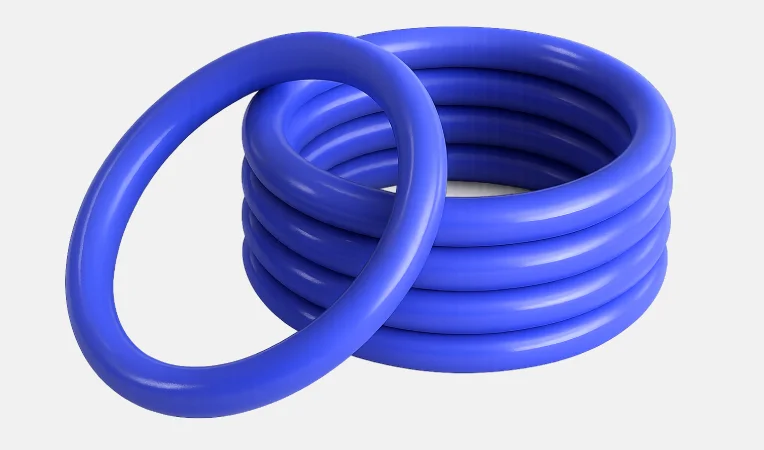
Fluorosilicone O-Rings
Fluorosilicone O-rings are flexible sealing components to prevent leakage between mating surfaces exposed to fuel, oil, and extreme temperature swings. The silicone’s temperature range, with added chemical resistance, holds up in aerospace fuel systems, automotive engine bays, and outdoor equipment where standard elastomers break down.
Rubber Xpert Inc. guides customers to the right fluorosilicone O-ring specification for their application, as a trusted manufacturer serving buyers in the USA, from standard sizes to fully custom builds.
Buy Fluorosilicone O-Rings in Bulk from a Trusted Manufacturer
& Supplier, Rubber Xpert Inc.
Rubber Xpert Inc. delivers bulk fluorosilicone O-rings built on tooling, tight tolerances, and consistent material quality batch after batch.
We equip OEMs and industrial buyers with sealing solutions for demanding high-heat environments, from standard stock sizes to fully custom specs. Explore our full rubber O-ring lineup and let our team match the right material and size to your project.
Silicone O-Rings
Flexible, high- and low-temperature sealing for food-grade, medical, and outdoor exposure applications.
RING
01
EPDM O-Rings
Reliable sealing for water, steam, and outdoor systems exposed to weathering and polar fluids.
RING
02
Neoprene O-Rings
Balanced, cost-effective sealing for moderate oils, refrigerants, and weathering conditions.
RING
03
FKM O-Rings
Premium chemical and heat-resistant sealing for aggressive fuels, oils, and industrial fluids.
RING
04
HNBR O-Rings
Tough, abrasion-resistant sealing for continuous mechanical wear in oil-field drilling and refrigerant environments.
RING
05
Buna (NBR) O-Rings
Economical, oil-resistant sealing for fuel systems and general-purpose hydraulic equipment.
RING
06
Polyurethane O-Rings
High-strength, abrasion-resistant sealing for dynamic hydraulic and heavy-load pneumatic systems.
RING
07
Santoprene O-Rings
Flexible, chemical-resistant sealing for potable water and low-pressure fluid handling systems.
RING
08
Butyl Rubber O-Rings
Low gas permeability sealing for vacuum systems and moisture-sensitive electrical enclosures.
RING
09
Natural Rubber O-Rings
High-elasticity sealing for low-pressure mechanical applications requiring superior tear strength.
RING
10
AEM O-Rings
Heat- and oil-resistant sealing engineered for automotive powertrain and transmission environments.
RING
11
Why Buy Fluorosilicone O-Rings from Rubber Xpert Inc.?
The reasons to buy fluorosilicone O-rings from Rubber Xpert Inc. are listed below.
- Custom Compound Formulation: Fluorine content is adjusted per application to balance fuel resistance with cold flexibility.
- Dimensional Tolerance Control: Accuracy molding holds tight variance on cross-section and inner diameter.
- Material Traceability: Batch records support audits for aerospace and automotive buyers.
- Scalable Bulk Output: Production scales from prototypes to high-volume runs without retooling delays.
- In-House Molding Capability: Compression and injection molding are selected based on part geometry.
- Dedicated Engineering Support: Drawings are reviewed pre-quote to catch compatibility issues early.
- Post-Cure Inspection: Parts are dimensionally and hardness checked before packaging.
- End-to-End Order Management: One contact tracks the order from spec to shipping.
What Are Fluorosilicone O-Rings?
Fluorosilicone O-rings are circular sealing devices made from FVMQ, a fluorine-modified silicone elastomer combining fuel resistance with silicone’s flexibility. The round cross-section deforms when compressed inside a groove, filling surface irregularities between mating parts to block fluid or gas leakage.
Properties include broad temperature tolerance, fuel and oil resistance, and strong weathering stability, making it suited for static seals in demanding environments. Fluorosilicone offers lower tear strength and abrasion resistance than other elastomers, limiting its use in dynamic or high-friction applications.
What Materials and Fluorosilicone (FVMQ) Compounds Are Used to
Manufacture Fluorosilicone O-Rings?
FVMQ is a fluorosilicone elastomer built on a silicone backbone modified with trifluoropropyl groups for added fuel and oil resistance. Manufacturers compound it into different grades for specific needs. General-purpose grades suit standard fuel and oil sealing in automotive and industrial use.
High-temperature grades use improved curing systems for prolonged heat exposure in aerospace and engine applications. Food-grade compounds meet FDA standards for consumable contact. Medical-grade FVMQ undergoes added purity testing for USP Class VI or ISO 10993 compliance.
Fluorosilicone O-Rings Material Comparison Table
The Fluorosilicone O-Rings material comparison table is shown in the table below.
| Material / Compound | Temperature Capability | Flexibility | Chemical Resistance | Regulatory Suitability | Typical Applications | Key Limitations |
|---|---|---|---|---|---|---|
| Peroxide-Cured FVMQ | -60°C to 177°C | High, stable across the full range | Moderate resistance to fuels and mineral oils | Standard industrial specs | Automotive fuel lines, general fluid seals | Poor abrasion resistance, limited to static use |
| Platinum-Cured Fluorosilicone (LSR) | -60°C to 200°C | Very high, consistent post-cure elasticity | Strong resistance to hydrocarbon fuels | Meets tighter dimensional and purity specs for injection molding | Precision-molded seals, small-diameter O-rings | Higher tooling cost, requires specialized injection equipment |
| High-Temperature Stabilized FVMQ | Up to 200°C continuous, brief excursions higher | Moderate, stiffens near upper limit | Strong resistance to jet fuel and hydrocarbon exposure | Meets aerospace and defense material specs | Aircraft fuel system seals, engine gaskets | Fluid temperatures near 200°C can degrade fluids into acids that attack the compound |
| FDA-Compliant Fluorosilicone Compound | -60°C to 177°C | High, consistent softness across the range | Resistant to oils and fats used in food processing | Complies with FDA 21 CFR 177.2600 | Food processing equipment, beverage dispensing seals | Higher raw material cost than standard peroxide-cured stock |
| USP Class VI Fluorosilicone Compound | -60°C to 177°C | High, maintains elasticity after repeated sterilization | Inert to bodily fluids and common sterilants | USP Class VI, biocompatibility tested, autoclave and gamma-sterilizable | Implantable device components, medical device seals | Requires certified production controls, raising manufacturing cost |
How to Choose the Right Fluorosilicone O-Ring for Your Needs?
To know how to choose the right Fluorosilicone O-Ring for your needs, follow the eight steps below.
- Size and Cross-Section: Match the inner diameter and cross-section thickness to AS568 or metric groove standards to prevent gaps or excessive squeeze during installation.
- Hardness (Durometer): Select a 70 Shore A durometer for most static seals, or choose softer compounds for low-pressure conformability and harder compounds to resist extrusion under load.
- Temperature Range: Confirm the operating range falls within -60°C to 200°C, and specify a stabilized high-temperature compound when heat exposure runs near the upper limit.
- Pressure Requirements: Keep pressure within low to moderate ranges, since fluorosilicone's low tear strength risks extrusion through gland clearances at higher pressures.
- Media Compatibility: Verify exposure to jet fuel, hydrocarbons, or mineral oils falls within compatible limits, and avoid fluorosilicone where strong acids or ketones are present.
- Compression Set: Specify peroxide-cured compounds with improved compression set resistance to maintain sealing force under sustained static load.
- Regulatory Requirements: Choose FDA-compliant or USP Class VI certified compounds for food-contact or medical applications instead of standard industrial-grade fluorosilicone.
- Operating Environment: Take advantage of fluorosilicone's ozone and weathering resistance for outdoor or UV-exposed installations where general-purpose elastomers degrade faster.
Where Are Fluorosilicone O-Rings Commonly Used?
Fluorosilicone O-rings serve in industries where fuel exposure, temperature extremes, or dry-heat resistance push standard elastomers past their limits.
Aerospace
Jet fuel exposure combined with high-altitude temperature swings demands a seal that resists both cold brittleness and hot degradation. This balance keeps fluorosilicone the standard choice throughout the aerospace industry for fuel system and engine component seals.
Automotive Fuel Systems
Engine bays expose seals to gasoline, mineral oils, and sustained underhood heat simultaneously. Fluorosilicone handles the combination reliably, which is why fuel injectors and gasket applications in the automotive industry rely on the compound.
Oil & Gas Equipment
Wellhead and pipeline seals face hydrocarbon exposure with wide temperature fluctuations between surface and downhole conditions. Static valve and flange seals throughout the oil and gas industry depend on fluorosilicone's chemical stability to hold up under the shifts.
Industrial Machinery
Manufacturing equipment often runs hot while contacting lubricants and processing fluids that degrade standard rubber compounds. Fluorosilicone's dry-heat resistance makes it a fit wherever Industrial and Machinery applications combine thermal load with fluid contact.
Chemical Processing
Processing lines handle a mix of acids, solvents, and oxidizing agents that attack less resistant elastomers over time. Static seals in the Chemical Industry turn to fluorosilicone when the fluid list includes hydrocarbons with aggressive media.
Electronics & Electrical Equipment
Sealed enclosures need stable dielectric properties even as internal temperatures climb during operation. The stability under thermal and electrical stress supports its use in the Electronics Industry for connector and housing seals.
Marine Equipment
Saltwater exposure and constant UV load degrade rubber compounds through surface oxidation. Fluorosilicone's ozone resistance extends seal life in coastal equipment, including applications tied to the Military Industry where corrosion resistance is non-negotiable.

Frequently Asked Questions About
Fluorosilicone O-rings
Common questions about fluorosilicone O-rings and their performance are answered below.
The main advantages of using fluorosilicone O-rings over standard silicone are improved fuel and mineral oil resistance while retaining silicone's flexibility and wide temperature range. This makes it the better choice for hydrocarbon-exposed environments where standard silicone o-rings degrade over time.
Fluorosilicone O-rings operate between -60°C and 200°C, maintaining flexibility at cold-start temperatures while resisting heat degradation.
Some stabilized compounds extend slightly beyond the range for high-temperature excursions.
Fluorosilicone O-rings resist jet fuel, gasoline, mineral oils, and a range of hydrocarbon-based fluids commonly found in aerospace and automotive systems.
Exposure to strong acids, ketones, and brake fluids can still cause gradual breakdown of the compound over extended contact.
Fluorosilicone O-rings are used in aerospace, automotive fuel systems, oil and gas equipment, chemical processing, and outdoor electronics applications.
Their resistance to fuel and weather stability makes them a choice for marine and industrial machinery exposed to harsh operating conditions.
The main limitations or disadvantages of fluorosilicone O-rings are low tear strength, poor abrasion resistance, and a high coefficient of friction. The properties restrict the material to static seals rather than dynamic applications.
Need Custom O-Rings for Your Application?
Tell us your size, material, quantity or application requirements and our team will provide a competitive quote.
Materials
Manufacturing
& Fast Response
You can upload it with your enquiry.