
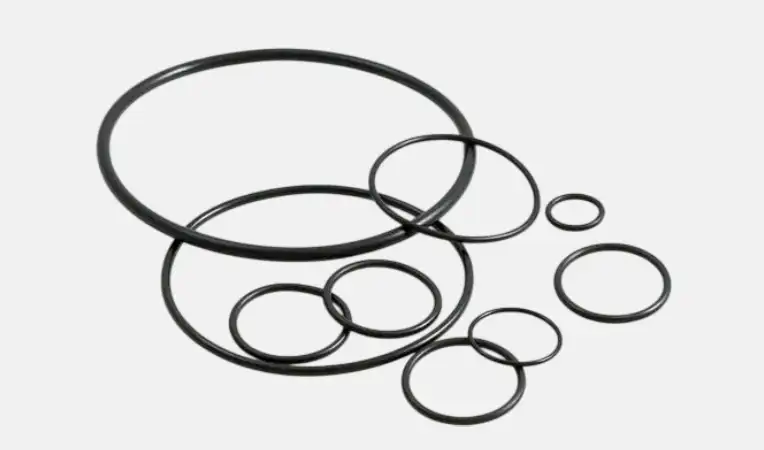
Butyl Rubber O-Rings
Butyl rubber O-rings are dense and low-permeability seals built to block gas and fluid migration between mating surfaces under sustained pressure and vibration. The resistance to ozone, moisture vapor, and polar chemicals makes them a strong fit for vacuum systems, chemical processing lines, and pharmaceutical equipment facing harsh operating conditions.
Rubber Xpert Inc. operates as a trusted USA-based manufacturer of Butyl rubber O-rings, giving buyers direct access to molded seals built for industrial use.
Buy Butyl Rubber O-Rings in Bulk from a Trusted Manufacturer
& Supplier, Rubber Xpert Inc.
Rubber Xpert Inc. supplies bulk butyl rubber O-rings for OEM manufacturers and industrial plants needing quality in large runs. We use compression and injection molding, blending butyl compounds with curing cycles for hardness and chemical resistance.
Custom sizes range from small seals under 10mm ID to heavy-duty rings over 500mm ID, verified through durometer testing and dimensional inspection covering AS568 dash sizes. It gives OEM buyers a rubber O-rings they specify once and reorder with confidence.
Silicone O-Rings
Flexible, temperature-stable sealing engineered for aerospace, medical, and industrial use.
RING
01
EPDM O-Rings
Weather- and steam-resistant sealing engineered for outdoor and fluid-system use.
RING
02
Neoprene O-Rings
UV- and chemical-resistant sealing built for refrigeration and outdoor equipment use.
RING
03
Fluorosilicone O-Rings
Fuel- and chemical-resistant sealing engineered for aerospace and fluid-system use.
RING
04
HNBR O-Rings
Abrasion- and oil-resistant sealing built for high-pressure automotive and drilling use.
RING
05
Buna (NBR) O-Rings
Oil and fuel-resistant sealing built for hydraulic and industrial machinery use.
RING
06
Polyurethane O-Rings
Abrasion- and tear-resistant sealing built for heavy machinery and hydraulic use.
RING
07
Santoprene O-Rings
Durable, low-maintenance sealing built for plumbing and outdoor equipment use.
RING
08
Natural Rubber O-Rings
Natural resilience and elasticity for general-purpose, non-oil sealing applications.
RING
09
AEM O-Rings
Heat- and oil-resistant sealing built for transmission fluids, powertrain heat, and engine bay durability.
RING
10
Why Buy Butyl Rubber O-Rings from Rubber Xpert Inc.?
The reasons to buy butyl rubber O-rings from Rubber Xpert Inc. are listed below.
- Custom Manufacturing: Cross-section, diameter, and compound ratio are modified to match the exact drawing submitted.
- Material Selection: Pharmaceutical-grade and industrial-grade polymers are sourced based on the application’s exposure profile.
- Dimensional Accuracy: Tight tolerances are held under AS568 and ISO 3601 standards.
- Quality Control: Compression set tests, hardness checks, and defect scans run before every release.
- Bulk Production: Output scales for high-volume orders while durometer and cure time stay consistent.
- Technical Support: Compound selection and application compatibility guidance is available from initial inquiry.
- Delivery Reliability: Lead times are tracked for on-time domestic and international fulfillment.
What Are Butyl Rubber O-Rings?
Butyl rubber O-rings are circular elastomeric seals, molded from isobutylene-isoprene copolymer to precise AS568 dimensions, to block gas and fluid migration between mating surfaces.
Compression inside a properly designed groove deforms the cross-section, generating continuous radial force that delivers an airtight, low-permeability seal for industrial projects.
What Materials and Butyl Rubber (IIR) Compounds Are Used to
Manufacture Butyl Rubber O-Rings?
Warning: Undefined array key "rubber_product_material_main_desc" in /home/u221192900/domains/rubberxperts.com/public_html/wp-content/themes/rubberexperts/templates/sub-product-details-template-new.php on line 374
Rubber Xpert Inc. selects isobutylene-isoprene copolymer as the base elastomer, then formulates it into general-purpose, high-temperature, food-grade, and medical-grade compounds using specialized materials for manufacturing suited to each application.
General-purpose grades favor cost efficiency and gas impermeability, while food-grade and medical-grade formulations meet FDA and USP Class VI standards for sanitary, chemical-resistant sealing performance.
Butyl Rubber O-Rings Material Comparison Table
The Butyl Rubber O-rings material comparison is shown in the table below.
| Compound Type | Temperature Capability | Flexibility | Chemical Resistance | Regulatory Suitability | Typical Applications | Key Limitations |
|---|---|---|---|---|---|---|
| General-Purpose | -40°C to 120°C | Moderate. Holds shape under cyclic load | Strong vs. polar solvents, ozone, moisture | ASTM D2000 industrial specs | Gaskets, valves, pneumatic seals, innertubes | Poor oil and fuel resistance |
| High-Temperature | -30°C to 150°C | Firmer, less elongation at peak heat | Retains ozone and steam resistance | ASTM D2000 heat-aging class | Steam systems, autoclave seals, curing equipment | Faster compression set above rating |
| Food-Grade | -40°C to 121°C | Moderate, sanitation-cycle rated | Resists cleaning agents, steam, mild acids | FDA 21 CFR 177.2600 | Beverage dispensers, food valves, packaging equipment | Narrower chemical range than fluoroelastomers |
| Medical-Grade | -40°C to 130°C | Moderate, low extractables | Resists sterilants, saline, autoclave steam | USP Class VI, ISO 10993 | Drug delivery seals, syringe parts, diagnostics | Higher cost, longer certification lead time |
How to Choose the Right Butyl Rubber O-Ring for Your Needs?
Choosing a butyl rubber O-ring means weighing groove fit, durometer, thermal ceiling, and media exposure against real operating conditions before placing an order.
To choose the right butyl rubber O-ring for your needs, follow the eight steps below.
- Size and Cross-Section: Check the inner diameter, outer diameter, and cross-section against groove dimensions, since undersized or oversized rings cause leaks or premature wear.
- Hardness (Durometer): Select a durometer based on pressure load and surface finish, where softer grades seal rough surfaces and harder grades resist extrusion at high pressure.
- Temperature Range: Confirm operating temperature stays within the compound's rated ceiling, since general-purpose IIR reaches 120°C and high-temperature IIR extends to 150°C.
- Pressure Rating: Match cross-section thickness and durometer to system pressure, as higher loads demand firmer compounds to prevent extrusion into the gland gap.
- Media Compatibility: Confirm fluid and gas exposure against IIR's known strengths, since butyl resists ozone, moisture vapor, and polar solvents but degrades under petroleum oils and hydrocarbon fuels.
- Compression Set: Check the compound's compression set rating, since a ring that fails to rebound after sustained load loses sealing force over time.
- Regulatory Requirements: Confirm certification needs early, since food-grade IIR meets FDA 21 CFR 177.2600 and medical-grade IIR meets USP Class VI and ISO 10993 standards.
- Operating Environment: Factor in UV exposure, sterilization cycles, and ambient humidity, since outdoor and steam-heavy conditions favor high-temperature or medical-grade IIR over general-purpose compounds.
Where Are Butyl Rubber O-Rings Commonly Used?
Butyl rubber O-rings are selected in industries where gas impermeability, ozone exposure, and sterile handling compromise standard elastomer seals.
The industries that depend on butyl rubber O-rings are outlined below.
Automotive
Butyl O-rings seal fuel components and tire valve stems, resisting ozone under vibration and heat. The automotive industry relies on IIR's moisture-vapor barrier for weather-exposed parts.
Chemical Processing
Butyl O-rings resist solvents, acids, and alkalis in valve seals and gaskets. The chemical industry trusts IIR to prevent leaks in reactors and transfer piping.
HVAC & Refrigeration
Butyl O-rings seal refrigerant lines and compressor fittings against pressure loss. The HVAC industry chooses IIR for moisture resistance through thermal cycling.
Pharmaceutical & Medical Equipment
Butyl O-rings form vial stoppers and syringe seals that preserve drug stability. The medical industry specifies USP Class VI-certified IIR for sterile sealing.
Gas Handling Systems
Butyl O-rings seal valves and pipeline fittings against gas migration. The oil and gas industry relies on IIR's ozone resistance for outdoor pipelines.
Industrial Machinery
Butyl O-rings seal hydraulic fittings and rotating equipment under cyclic loads. The industrial and machinery operations choose IIR for lasting durability.
Sealing & Fluid Handling Equipment
Butyl O-rings fit pumps, flanges, and couplings across variable pressures. Manufacturers specify IIR for dimensional stability in fluid systems.

Frequently Asked Questions About
Butyl Rubber O-Rings
Common questions about Butyl rubber O-ring performance and application help buyers determine fit for gas-tight and vacuum systems.
Butyl rubber O-rings are synthetic elastomer seals made by copolymerizing isobutylene with a small amount of isoprene, designated as IIR.
Their primary properties are low gas permeability, strong shock and vibration damping, and resistance to heat, ozone, and weathering.
The temperature range for Butyl rubber O-rings is -50°C to +120°C, with some compounds rated up to 150°C depending on formulation. It allows the material to hold its seal in cold storage environments and moderately heated industrial systems.
The chemical and gas compatibility of Butyl O-rings includes acetone, ketones, and esters, with dilute acids, alkalis, and heavy steam exposure. They have zero resistance to petroleum-based oils, gasoline, diesel, and hydrocarbon solvents, which trigger swelling and rapid seal failure on contact.
Butyl rubber O-rings are ideal for gas impermeability and vacuum sealing because their dense molecular structure keeps gas from passing through the material.
Compressing the ring inside the groove tightens the seal even more, which is why Butyl performs well in vacuum chambers and pressurized-gas systems.
The main advantages are low gas permeability, ozone resistance, and vibration damping, all valuable in static and low-cycle sealing setups. The disadvantage is slow elastic recovery at room temperature, which rules the material out for high-speed rotary shafts or fast-reciprocating pistons.
You should avoid using Butyl rubber O-rings when carrying petroleum-based lubricants, motor oils, hydraulic fluids, or hydrocarbon fuels, since contact causes immediate swelling and blowout.
Applications needing vacuum performance and oil resistance call for FKM or FFKM compounds instead.
Common industries and applications for Butyl O-rings include tank liners, pipeline gaskets, valve seals, and storage bladders where gas containment matters most.
The material serves ultra-high vacuum chambers, pressurized gas bellows, and protective gear requiring an airtight seal.
Butyl rubber leads in gas and vacuum performance, a category where EPDM and NBR fall behind due to their more open molecular structure. The EPDM O-ring instead offers superior steam and weathering resistance, while NBR provides the oil and fuel resistance that Butyl fundamentally lacks.
Need Custom O-Rings for Your Application?
Tell us your size, material, quantity or application requirements and our team will provide a competitive quote.
Materials
Manufacturing
& Fast Response
You can upload it with your enquiry.