

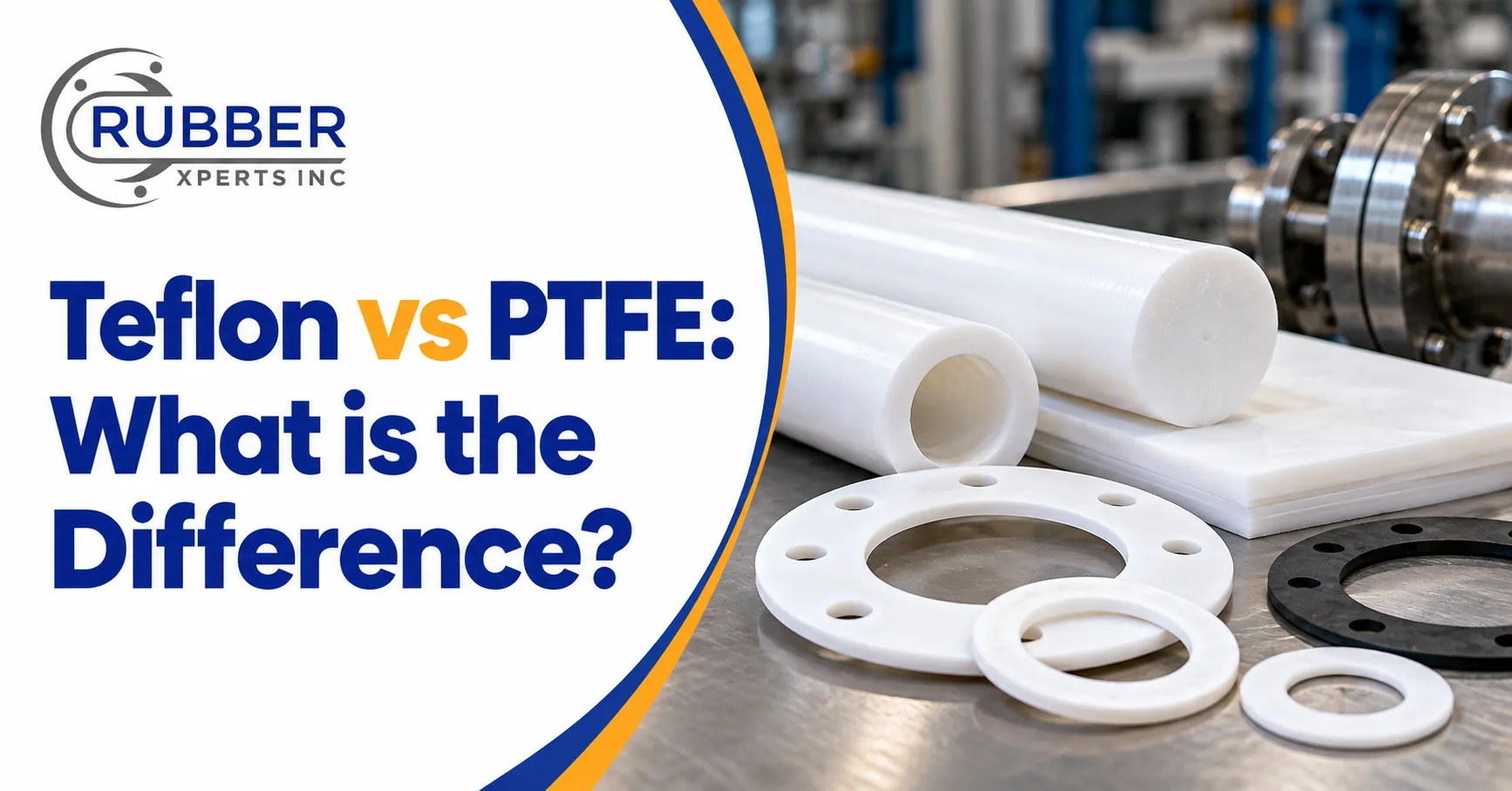
If you have shopped for sealing components, you have probably seen the same material described as both “Teflon” and “PTFE” in the same breath, sometimes even on the same product page. The two terms get used interchangeably so often that it is easy to assume they refer to two different materials. In reality, the comparison is less about chemistry and more about branding. PTFE is the material, while Teflon is a trademarked brand DuPont created for its version of that material.
That distinction matters more than it might seem, especially once you move from general plastics into rubber gaskets. A gasket described as “PTFE” and one described as “Teflon” can come from different manufacturers, meet different certifications, and carry different price tags, even though they are from the same underlying polymer. Below, we will walk through what each term means, how they relate, and what the practical differences look like once PTFE and Teflon show up in gasket form.
What Is a PTFE Gasket?
PTFE is an abbreviation for polytetrafluoroethylene, a fluoropolymer valued for its exceptional sealing capabilities under challenging process conditions. A PTFE gasket offers strong chemical resistance, holds up across a wide temperature range, and has an unusually low coefficient of friction compared to most sealing materials. Those characteristics make it a common choice for various applications because it resists aggressive chemicals or extreme temperatures without breaking down. PTFE is a generic material rather than a brand, so manufacturers across industries produce PTFE gaskets for different price points.
What Is a Teflon Gasket?
Teflon is a trademarked brand name owned by Chemours (formerly part of DuPont), and it is most commonly associated with PTFE. Teflon is one manufacturer’s branded version of PTFE, which emphasizes its quality, similar to how a brand name sits alongside a generic product category in other industries.
This means a Teflon gasket is a gasket made from Teflon-branded PTFE. It is not a separate material competing against PTFE; it is PTFE that carries a specific brand name and, typically, a manufacturing pedigree tied to that brand. Because of that relationship, it is best to avoid framing Teflon and PTFE as two different materials going up against each other. The real comparison is closer to comparing a branded product to its generic counterpart.
Is PTFE the Same as Teflon?
Yes, PTFE is the generic material name, and Teflon is a trademarked brand name for a specific manufacturer’s version of that material. Every Teflon gasket is a PTFE gasket, but not every PTFE gasket is Teflon-branded.
This difference is mostly about branding and product sourcing rather than differences in chemistry. A gasket labeled simply “PTFE” may have come from any number of manufacturers producing the material to varying specifications, while a gasket labeled “Teflon” traces back to Chemours’ branded product line and its associated quality documentation.
PTFE vs. Teflon Gaskets: What Is the Difference?
Following the practical differences between PTFE gaskets and Teflon-branded gaskets, look at where the two actually diverge: material sourcing, formulation, and the paperwork that comes with them, rather than the base chemistry.
Material: Both are polytetrafluoroethylene at their core. The polymer itself does not change based on the brand name attached to it.
Branding: PTFE is a generic designation, while Teflon is a specific trademark. Any compliant manufacturer can call its product PTFE; only Chemours and its licensed converters can label a product Teflon.
Formulation: Not all PTFE is formulated the same way. PTFE (Teflon) gaskets can be produced as virgin PTFE, filled PTFE with additives such as glass or carbon, or expanded PTFE, and each formulation changes how the finished gasket performs.
Quality control: Branded Teflon products typically come with more consistent, brand-controlled manufacturing standards, since Chemours licenses and monitors the trademark’s use.
Certifications: Teflon-branded gaskets are more likely to carry specific brand-backed certifications and documentation, which matters in regulated industries like food processing, pharmaceuticals, or aerospace.
Availability: Generic PTFE gaskets are widely available from many suppliers at varying price points, while Teflon-branded gaskets come from a narrower set of licensed manufacturers.
Cost: Teflon-branded PTFE gaskets tend to be more premium and pricey than unbranded generic PTFE gaskets because of the branding, quality assurance, and documentation.
The gasket’s performance does not depend on its brand but on manufacturing quality, specific PTFE grade, and any fillers used.
PTFE vs. Teflon Gaskets: Key Properties
Since PTFE and Teflon share the same base chemistry, their performance characteristics largely overlap. The table below summarizes the properties that matter most when selecting a gasket for a sealing application.
|
Property |
What It Means for the Gasket |
|
Chemical resistance |
Resists a broad range of acids, bases, and solvents, making it suitable for aggressive process chemicals |
|
Temperature resistance |
Performs across a wide operating temperature range, from cryogenic conditions to several hundred degrees Fahrenheit |
|
Low friction |
One of the lowest coefficients of friction of any solid material, reducing wear in dynamic sealing applications |
|
Electrical insulation |
Functions as an effective electrical insulator, useful in applications where dielectric properties matter |
|
Compression behavior |
Compresses to conform to flange or fitting surfaces, though it can also cold-flow under sustained load |
|
Creep resistance |
Prone to creep (also called cold flow) over time under constant pressure, which is why fillers are often added to improve dimensional stability |
Note that virgin PTFE, filled PTFE, and expanded PTFE (ePTFE) do not perform the same. Virgin PTFE offers the purest chemical resistance but creeps more readily under load. Additives filled with PTFE, like glass fiber, carbon, or bronze, trade a small amount of chemical resistance for better creep resistance and mechanical strength. Expanded PTFE is manufactured to conform more easily to irregular flange surfaces, which makes it a common choice for challenging sealing geometries.
PTFE vs. Teflon Gaskets: Chemical Resistance
PTFE, whether generic or Teflon-branded, is one of the most chemically inert materials used in gasket manufacturing. It resists degradation from strong acids, strong bases, and most solvents that would break down rubber or many plastics over time, making it a default choice for sealing in rubber-resistant gaskets in demanding process environments.
That said, chemical resistance should still be checked against the specific chemical and the operating conditions involved. Concentration, temperature, and exposure duration can all affect how a gasket performs in practice, so compatibility charts for the exact chemical in use are worth consulting before finalizing a material choice, rather than relying on PTFE’s general reputation for chemical resistance alone.
PTFE vs. Teflon Gaskets: Temperature Resistance
PTFE gaskets typically handle continuous operating temperatures from around -450°F up to roughly 500°F, depending on the specific grade and formulation. That range makes PTFE useful in both cryogenic sealing applications and high-temperature gasket applications, though it is worth focusing on continuous operating temperature rather than the material’s melting point alone, since a gasket’s real-world performance depends on more than the point at which the polymer physically melts.
Pressure, gasket design, and the specific PTFE formulation all affect how the material performs at temperature. A filled PTFE gasket under high compressive load, for example, may behave differently at the upper end of its temperature range than an unfilled, lightly loaded high-temperature gasket of the same nominal material.
When Should You Use a PTFE Gasket?
To know when to use a PTFE gasket, follow the tips below.
- Aggressive chemical exposure: Sealing environments involving strong acids, caustics, or solvents that would degrade rubber or standard plastic gaskets.
- Wide temperature swings: Applications that need reliable sealing across both very low and very high operating temperatures.
- Low-friction requirements: Dynamic seals or applications where reduced friction extends component life.
- Electrical insulation needs: Sealing applications where the gasket also needs to act as a dielectric barrier.
- Regulatory or purity requirements: Food, pharmaceutical, or high-purity processes where a chemically inert, non-reactive material is required.
In these situations, whether the gasket is generic PTFE or Teflon-branded PTFE, the underlying material properties are what make it the right fit. The choice between a generic and a branded option then comes down to budget, required certifications, and how much documentation and traceability the application demands.