

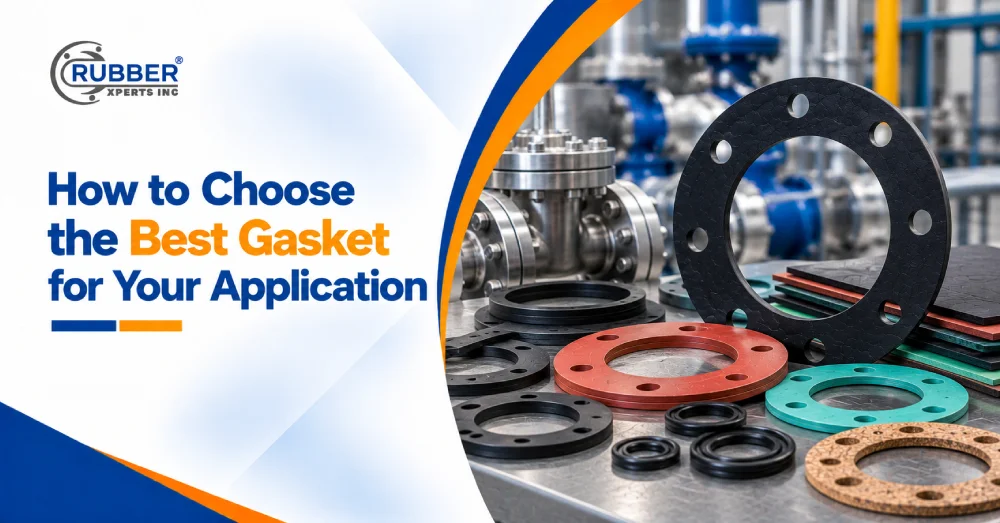
Choosing the right gasket affects sealing performance, safety, and service life. The right choice depends on material, application, design, and configuration together, never any single factor on its own. This guide outlines the gasket material selection criteria, including chemical compatibility, temperature range, pressure conditions, gasket type, design and configuration, and application-specific requirements such as sanitary or grooved-piping systems.
What Factors Should You Consider When Choosing a Gasket?
The factors you should consider when choosing a gasket are listed below.
- Material compatibility: the gasket material must resist chemical attack and hold its properties across the system’s full temperature range.
- Operating pressure and application type: higher-pressure systems demand materials with sufficient tensile strength and low compression set, since underrated gaskets extrude or blow out under load.
- Gasket design, configuration, and sizing: thickness, shape, and bolt pattern must match the specific flange or joint, or even the correct material will leak.
- Reusability and maintenance requirements: how often the joint will be opened and resealed affects which material and configuration make sense.
- Regulatory or industry requirements: sanitary, food-grade, and other regulated applications narrow the acceptable material list before weighing factors.
How Do You Select the Right Gasket Material?
Chemical exposure, temperature range, and pressure drive material selection. No single gasket material performs best across different conditions. A gasket that excels with steam and water fails quickly in contact with petroleum oils, and vice versa. Low chemical compatibility, temperature range, and pressure are sub-factors narrowing the list of materials before you even consider gasket type or configuration.
What Chemical Compatibility Should You Check Before Selecting a Gasket Material?
Chemical compatibility should be checked against the specific fluids, gases, and cleaning agents the gasket will actually contact, not just the primary process media. Swelling, softening, or cracking after exposure are the clearest signs of poor compatibility, and any of them signal that the material needs to be swapped before the gasket goes into service. Our gasket chemical resistance breaks down resistance ratings by material and chemical class.
What Temperature Range Should the Gasket Material Withstand?
Check both the continuous operating temperature and any peak excursions the system might see during startup, shutdown, or upset conditions. Some materials lose elasticity and sealing force at low temperatures, while others degrade faster than expected at the high end of their rated range. For systems running hot, see our guide to high-temperature gaskets for materials built to hold up under sustained heat.
What Pressure Conditions Affect Gasket Material Selection?
Higher-pressure applications require materials with enough tensile strength and a low enough compression set to keep sealing force after the initial bolt-up. Pressure and flange load are directly connected: the clamping force the flange bolts apply has to be enough to compress the gasket material without exceeding its tensile strength, or the gasket will extrude out from between the flange faces under load.
What Are the Best Gasket Materials for Common Applications?
When selecting gasket materials for various applications, you should consider the specific requirements and conditions each material must withstand. Different gasket materials, including rubber gaskets, offer unique properties that make them suitable for specific conditions, whether it be high temperatures, chemical exposure, or mechanical stress.
The best gasket materials for common applications are listed below.
- Silicone Gasket: broad temperature tolerance and strong performance in food-grade and medical applications.
- EPDM Rubber Gaskets: strong resistance to water, steam, and weathering, common in HVAC and plumbing systems.
- Neoprene Rubber Gaskets: balanced, general-purpose resistance to moderate chemicals, oils, and outdoor exposure.
- Nitrile (Buna-N) Rubber Gaskets: strong oil and fuel resistance, a standard choice for automotive and hydraulic systems.
- PTFE (Teflon) Gaskets: the broadest chemical resistance of any common gasket material, suited to aggressive acids and solvents.
- Cork Gaskets: low-pressure sealing with good vibration dampening, often used where gentler clamping force is available.
Gasket vs O-Ring: Which Should You Use?
Gaskets and O-rings are different products built for different joint geometries. A gasket is a flat or molded seal placed between two mating flange or cover surfaces, while an O-ring is a circular cross-section seal that fits into a groove around a shaft, port, or cylindrical fitting. As a rule of thumb, use a gasket for flat, static flange joints and an O-ring for cylindrical or rotating interfaces. Our gasket vs O-ring comparison covers the distinction in more detail.
Die Cut vs Spliced and Vulcanized Gaskets: What’s the Difference?
Die cutting produces flat sheet gaskets by stamping a shape from rubber stock, and it’s the standard method for standard flange sizes and moderate production runs. Splicing and vulcanizing joins strips of gasket material into a continuous ring, which is the preferred method for large-diameter gaskets or custom lengths that a single die-cut sheet can’t cover efficiently. See our die-cut gaskets and spliced & vulcanized gaskets product pages for specifics on each.
How Does Gasket Design and Configuration Affect Selection?
Gasket shape, thickness, and bolt pattern must match the specific joint or flange it seals. An otherwise correct material will still leak if the configuration doesn’t match the joint thickness, if it’s wrong for the flange’s surface finish, or if the bolt pattern doesn’t align, defeating even the best chemical and temperature match.
What Gasket Configurations Are Common for Flanged Joints?
The gasket configurations common for flanged joints are listed below.
- Full-face gaskets: cover the entire flange face and distribute bolt load evenly, used on flat-face and raised-face flanges alike.
- Ring-type (inside-bolt-circle) gasket: sits only within the bolt circle, concentrating sealing force where it’s needed on raised-face flanges rated for higher pressure.
- Spiral-wound gaskets: combine a metal winding with a soft filler material, used in high-pressure and high-temperature process piping where standard rubber gaskets aren’t rated.
For more information on selecting the right flange gaskets for your specific needs, explore our comprehensive resources. Understanding common configuration options by flange class can significantly enhance your sealing performance and application success.
How Do You Size and Specify a Gasket for Your Application?
To size and specify a gasket for your application, follow the steps below.
- Measure the flange or joint dimensions, including inside diameter, outside diameter, and bolt circle.
- Confirm the thickness needed to compensate for the uneven surface of the flange faces.
- Confirm the durometer, or hardness, needed for the clamping force your bolts can actually deliver.
- Confirm the finish and tolerance requirements specified for the joint.
How Does the Application Determine Gasket Selection?
The end-use environment’s sanitary processing, general piping, or heavy industrial process narrows both material and configuration choices beyond what general material data alone would suggest. Applications considered for similar chemical resistance still need different gaskets once regulatory requirements or joint hardware are included.
How Do You Select a Gasket for Sanitary or Food-Grade Applications?
Sanitary and food-grade applications add requirements beyond standard chemical and temperature compatibility: FDA or 3-A compliance, ease of cleaning, and resistance to the CIP/SIP (clean-in-place, sterilize-in-place) chemicals used during routine sanitation. Silicone and certain EPDM grades are the most common material choices for sanitary service, since they combine broad temperature tolerance with the regulatory approvals these systems require.
How Do You Select a Gasket for Grooved Piping and Coupling Systems?
Grooved and coupling systems, the Victaulic-style couplings common in fire protection and HVAC piping, require gaskets matched to the specific coupling manufacturer’s groove profile and pressure rating, since these gaskets are sized to the coupling housing rather than cut to a generic flange dimension. Material selection for these systems still follows the same chemical and temperature logic. The coupling profile is an additional fit requirement on top of it.
Does Gasket Reusability Influence Material Selection?
Yes, reusability influences material selection. Whether a gasket can be reused depends on the material’s compression set behavior and whether it was overcompressed the first time it was installed. A gasket compressed beyond its rated range typically won’t reseal reliably even if it looks undamaged. If you’re planning for a gasket that will be removed and reinstalled repeatedly, that expectation should shape the material and configuration choice up front, since not every material recovers well enough after decompression to make reuse practical.
How Is Choosing a Gasket Different From Choosing Packing?
Gasket sealing sits between two surfaces that don’t move relative to each other, like a flange joint. Packing, by contrast, seals dynamic interfaces such as rotating shafts, where the sealing material has to accommodate continuous motion rather than just clamping force. The selection criteria covered in this guide apply specifically to gaskets, not packing; see how gaskets are different from packing for a full comparison.
How Do You Confirm a Gasket Will Perform Before Full Deployment?
Material and performance testing is how you confirm a gasket selection before committing to a full production run or installation. Testing verifies compressibility, dimensional accuracy, and leak performance under real operating pressure, catching problems before they show up as failures in the field. Our gasket testing page covers the specific tests used to validate a selection.
Can One Gasket Material Work Across Multiple Applications?
Yes, some general-purpose materials can work across multiple applications. EPDM and nitrile, in particular, cover a wide range of common uses because their chemical and temperature ranges are broad enough for general water, air, and moderate-oil service. Demanding conditions, aggressive chemicals, high temperatures, or sanitary compliance still require an application-specific material rather than a general-purpose default.