

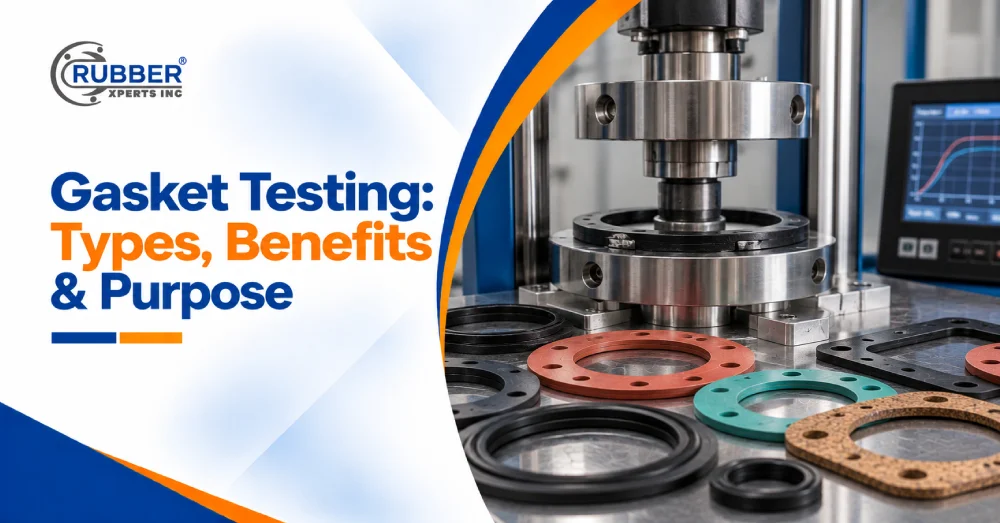
Before a gasket is installed in a flange, engine, or process line, it typically undergoes testing. Gasket testing evaluates both the gasket material and finished construction to confirm its performance in demanding applications, rather than relying solely on the specification sheet.
Testing is necessary to determine its reliability, safety, durability, and suitability for a specific application. A gasket that looks correct on paper can still fail in service if its hardness, tensile strength, chemical resistance, or temperature tolerance were never confirmed under conditions similar to where it will actually be used. Below, we will walk through what gasket testing covers, the major testing methods and standards involved, and the practical benefits of building testing into a gasket selection process.
What Is Gasket Testing?
Gasket testing involves evaluating a gasket’s physical, mechanical, and chemical characteristics to ensure it perfectly seals under its designated operating conditions. It answers whether a given material and design will actually hold up once installed, rather than leaving that answer to guesswork.
Testing generally falls into three categories. Material testing evaluates the raw compound itself, things like hardness, tensile strength, and chemical resistance, before it is ever formed into a gasket. Performance testing looks at how that material behaves under simulated operating conditions, such as elevated temperature or sustained compression. Finished-gasket testing evaluates the actual manufactured part, checking dimensions, sealing performance, and leak resistance once it is in its final form. Testing levels cover the properties that matter most for gasket selection: hardness, tensile strength, chemical resistance, temperature resistance, and compression set.
Why Is Gasket Testing Essential?
Gasket testing matters because it is one of the most direct ways to prevent leakage and premature failure before installation. Untested gaskets intended for chemical, temperature, and pressure conditions are essentially an unverified assumption sitting between two mating surfaces.
Testing supports quality control by catching material inconsistencies before they reach the field, and it supports safety by confirming a gasket can handle the pressures and other conditions. Test data lets an engineer or buyer compare selected materials against the real-world application, rather than relying on generic product descriptions. A material that performs well in a lab test at room temperature does not guarantee the same performance at 400°F in the presence of an aggressive solvent, which is why testing protocols are built around the specific conditions a gasket will face.
What Are the Different Types of Gasket Testing Methods?
Gasket testing covers a range of properties, each evaluated through its own method:
- Hardness testing: Measures a material’s resistance to indentation, typically using a Shore durometer for rubber and elastomeric gaskets.
- Tensile strength and elongation testing: Stretches a material specimen until it breaks, recording the force required and how far it stretched before failure.
- Chemical resistance testing: Exposes a gasket material to specific chemicals or service media and measures resulting changes in volume, mass, or hardness.
- Temperature resistance testing: Evaluates how a material performs at its expected operating temperatures, including heat aging and temperature cycling where applicable.
- Compression set testing: Measures how much a material fails to recover its original thickness after being compressed for a set period.
- Leak and closure testing: Tests an assembled gasket under controlled pressure to measure actual sealing performance rather than isolated material properties.
- Failure analysis: Examines gaskets that have already failed in service to identify the root cause and prevent repeat failures.
What ASTM and ISO Standards Apply to Gasket Testing?
Different ASTM and ISO standards apply depending on the material being tested and the property in question, since a hardness test and a chemical resistance test call for entirely different procedures. For rubber and elastomeric gasket materials, common examples include ASTM F104, which classifies non-metallic gasket materials, ASTM F36, which covers compressibility and recovery testing, and ASTM F152, which addresses tension testing of non-metallic gasket materials. ISO standards cover similar ground internationally, often used alongside or in place of ASTM standards depending on the region and industry.
Because these standards are tied to specific materials and specific properties, the applicable standard depends on both what the gasket is made of and what is being measured. A standard for testing fiber gasket compressibility may not suit fluoropolymer chemical resistance testing, emphasizing the need to choose the right standard before testing.
How Do You Select the Right ASTM Gasket Testing Standard?
To select the right ASTM gasket testing standard, follow the steps below.
- Identify the gasket material and the property being tested. Different materials and properties have different standards, so this step narrows the field.
- Consider the application’s operating conditions. Operating temperature, pressure, and chemical exposure all affect which test is relevant and which results actually matter.
- Confirm the current version and scope of the standard. ASTM standards are periodically revised, so verify the referred version is current and that its scope actually covers the material and property in question.
Is ASTM a US Standard?
Yes, in origin: ASTM stands for the American Society for Testing and Materials, and the organization was founded in the United States. However, ASTM standards are used internationally, not just domestically.
Manufacturers and industries outside the US often reference ASTM standards because they are well documented, widely recognized, and provide a consistent basis for comparing materials across different suppliers and regions. In practice, this means an ASTM designation on a gasket material’s test data does not indicate it is only relevant to US-based applications.
How Is Material Hardness Evaluated in Gasket Testing?
Hardness measures the resistance to indentation of the material, and it plays a direct role in how a gasket compresses and seals against a mating surface. A material that is too soft may extrude under pressure, while one that is too hard may not conform well enough to fill surface irregularities.
For elastomers, hardness is most commonly evaluated using Shore hardness testing, which measures the depth of indentation left by a standardized durometer. The resulting value gives a quick, comparable indication of how a material will behave under compression, which directly affects sealing performance at the flange or joint.
How Is Tensile Strength Evaluated in Gasket Testing?
Tensile strength and elongation describe how much force a material can withstand before breaking and how far it stretches in the process. To evaluate gasket tensile strength, a specimen of the gasket material is clamped and stretched at a controlled rate until it fails, while the applied force and elongation are recorded throughout.
The resulting data indicates how well a material resists mechanical stress, which matters for gaskets that experience clamping loads, vibration, or thermal cycling over their service life. A material with low tensile strength may be more prone to tearing during installation or under sustained mechanical stress in the field.
How Is Tensile Strength Evaluated in Gasket Testing?
Tensile strength and elongation describe how much force a material can withstand before breaking and how far it stretches in the process. To evaluate gasket tensile strength, a specimen of the gasket material is clamped and stretched at a controlled rate until it fails, while the applied force and elongation are recorded throughout.
The resulting data indicates how well a material resists mechanical stress, which matters for gaskets that experience clamping loads, vibration, or thermal cycling over their service life. A material with low tensile strength may be more prone to tearing during installation or under sustained mechanical stress in the field.
How Is Chemical Resistance Evaluated in Gasket Materials?
Chemical resistance is evaluated through exposure testing, where a gasket material sample is immersed in or exposed to the specific chemicals or service media it will encounter in actual use. This is one of the more application-specific tests, since resistance to one chemical says little about resistance to another.
During and after exposure, testers measure changes in volume, mass, hardness, swelling, cracking, and general degradation of the material. Significant swelling or softening, for example, indicates the chemical is being absorbed into the material, while cracking or hardening can point to chemical attack breaking down the polymer structure. For a broader view of how different gasket materials hold up across a range of chemicals, see this gasket material compatibility chart for chemicals.
How Is Temperature Resistance Evaluated in Gasket Materials?
Temperature resistance testing evaluates a gasket material at the temperatures it is actually expected to encounter in service, rather than only at room temperature. This often includes heat aging tests, where a sample is held at an elevated temperature for an extended period, and temperature-cycling tests, where a sample is repeatedly moved between temperature extremes.
Temperature directly affects a material’s elasticity, strength, sealing ability, and rate of degradation. A material that seals well at room temperature may lose elasticity and sealing force at low temperatures or soften and degrade faster than expected at high temperatures. For applications with demanding thermal requirements, a high-temperature gasket material should be tested specifically across its full expected operating range, not just at a single reference point.
What Is Compression Set Testing for Gaskets?
Compression set testing measures how much a gasket material permanently deforms after being compressed for a set period of time. In practice, a sample is compressed to a specified percentage of its original thickness, held for a defined duration and temperature, then released and measured to see how much of its original thickness it recovers.
A low compression set value means the material springs back close to its original shape, which matters because a gasket that stays compressed and loses its recovery is less able to maintain sealing force over time. Low compression set is especially important in applications where a gasket has to maintain a seal for years without regular retightening.
How Do Leak and Closure Tests Evaluate Gasket Performance?
To evaluate a gasket’s actual sealing performance, a complete gasket assembly is tested under controlled pressure and simulated operating conditions rather than testing the raw material alone. This typically involves installing the gasket in a test fixture that replicates the flange or joint it will be used in, then pressurizing the assembly to measure leakage.
Closure testing looks specifically at how well the gasket maintains a seal as the assembly is tightened and put under load, while leak testing quantifies any measurable loss of pressure or fluid across the seal. Together, these tests confirm whether a gasket performs as expected once it is actually installed, rather than relying solely on individual material property data.
How Does Gasket Failure Analysis Help Prevent Leakage and Degradation?
When a gasket fails in service, failure analysis examines the failed part to identify the root cause rather than simply replacing it and hoping the same failure does not recur. This typically involves visual inspection, material testing on the failed sample, and comparison against the original operating conditions the gasket was exposed to.
Common failure modes include cracking from age or chemical exposure, extrusion where the gasket material is pushed out of the joint under pressure, excessive compression set that leaves the gasket unable to maintain a seal, chemical attack that degrades the polymer structure, and thermal degradation from prolonged exposure to excessive heat. Identifying which of these occurred helps determine whether the issue was a material selection problem, an installation issue, or an operating condition that exceeded the gasket’s design limits.
When Is Independent Gasket Lab Testing Necessary?
Independent rubber testing becomes necessary when in-house verification is not sufficient to confirm a gasket material’s performance or when a project requires documented, third-party test data. This is common in regulated industries, custom or critical applications, and situations where a manufacturer’s own published data needs independent confirmation before a material is approved for use.
Independent lab testing is also useful when troubleshooting an unexplained failure, qualifying a new material or supplier, or meeting a customer’s or regulator’s requirement for traceable, third-party test documentation rather than relying solely on a manufacturer’s internal data.
What Are the Benefits and Applications of Gasket Testing?
Gasket testing provides tangible benefits across material selection, quality assurance, and long-term reliability:
- Reduced risk of leakage and failure: Verified material and performance data lowers the chance of an unexpected seal failure in service.
- Informed material selection: Test data lets engineers and buyers compare candidate materials against actual application requirements instead of relying on general product claims.
- Consistent quality control: Routine testing catches material inconsistencies before gaskets are installed, rather than after a failure occurs.
- Documented compliance: Standardized test results provide the traceable documentation often required in regulated industries, such as chemical processing, food and beverage, and aerospace.
- Better troubleshooting: When a failure does occur, existing test data and failure analysis make it easier to pinpoint the cause and adjust material selection going forward.
- Confidence in demanding applications: For gaskets exposed to extreme temperatures, aggressive chemicals, or high-pressure conditions, testing confirms the material will actually perform under those specific conditions rather than under general-use assumptions.
Across industries from chemical processing to automotive and general industrial sealing, gasket testing is what turns a material’s theoretical properties into a verified basis for choosing the right gasket for the job.