

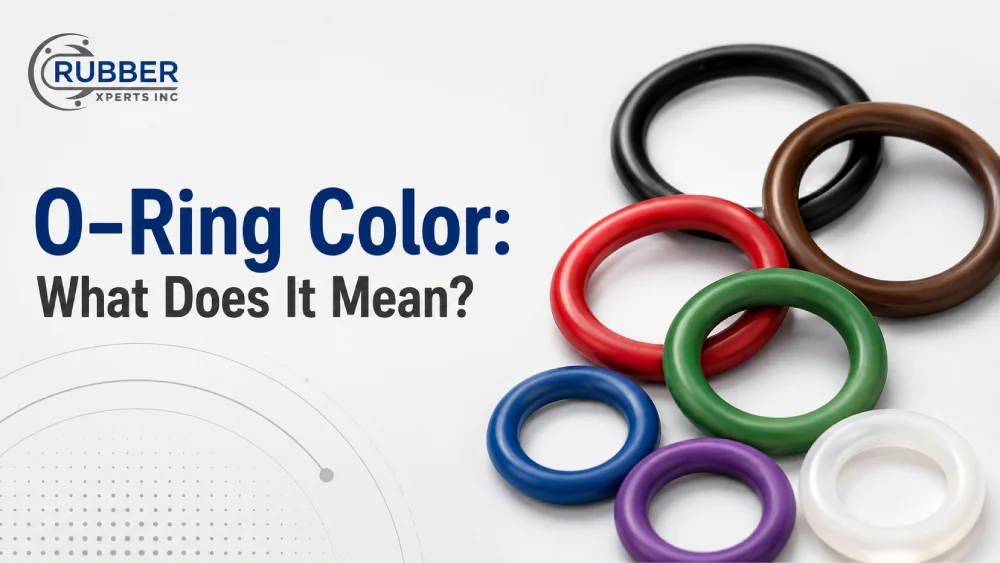
O-ring color indicates material type, hardness grade, and cure system, reducing installation mix-ups and ensuring the correct elastomer compound is specified for the right chemical and temperature environment in hydraulic, pneumatic, and industrial applications in the USA.
Color-specific O-ring seals support traceability in GMP-regulated and aerospace assembly lines, and a type of O ring seal with a circular cross-section prevents fluid or gas leakage. The rubber O-rings cover the complete elastomer grades and size standards available.
Why Do O-Rings Come in Different Colors?
O-rings come in different colors because manufacturers use pigmentation to communicate material type, hardness grade, and cure system, enabling faster identification in assembly, inventory management, and maintenance without physical testing.
Color conventions link hues to elastomer compounds: black for NBR, brown for FKM, and transparent/milk white for silicone, preventing material mix-ups in service environments. No universal standard mandates color-to-material mapping.
What Do Common O-Ring Colors Represent?
O-ring colors represent material type, hardness grade, and compound family. Below is an O-ring color chart breakdown of what black, red, green, brown, blue, white, and purple indicate in industries.
Black O-Ring
Black O-rings are Nitrile-Butadiene Rubber (NBR), the most used and affordable standard elastomer in the O-ring sector.
Carbon black is loaded at 40 to 90 phr and serves as the filler, giving NBR its characteristic color while operating within -30°C to +100°C in hydraulic systems, pneumatic systems, and general mechanical equipment.
Note that neoprene (CR), HNBR, and some FKM compounds are also black, making datasheet verification critical before installation.
Red O-Ring
Red O-Rings are silicone rubber (VMQ), rated for -55°C to 230°C with high flexibility and chemical inertness, making them a standard spec in food-grade sealing, medical devices, and high-temperature industrial equipment.
Manufacturers produce FKM and HNBR compounds in red or burgundy, so color alone is insufficient for compound verification without a material certificate.
Green O-Ring
Green indicates Hydrogenated Nitrile Butadiene Rubber (HNBR), which delivers better heat and chemical resistance than standard nitrile, but FKM/Viton is frequently produced in green.
EPDM is another green-coded compound, with strong resistance to weathering, ozone, and water, but it is incompatible with petroleum oils, making application context critical when green O-rings are specified.
Brown O-Ring
Brown is the traditional color for FKM, originating from iron oxide produced during early fluorocarbon polymerization, and aerospace procurement documents (AMS-R-83485) use brown as a visual traceability marker.
Brown NBR and EPDM compounds can be pigmented brown, so a certificate of conformance remains the only reliable verification method for sealing applications.
Blue O-Ring
Blue O-rings are FKM (Viton®), rated from -20°C to 250°C with chemical resistance, low permeability, and strong compression set resistance, specified in chemical processing, automotive fuel systems, and aerospace.
EPDM is also regularly available in blue, used in water, steam, and weather-exposed applications, making supplier confirmation essential when blue O-rings are pulled from inventory.
White O-Ring
White O-rings are silicone (VMQ) compounds, available in transparent and milk-white grades, and are the designated color for PTFE (Teflon) seals.
The materials are specified in pharmaceutical, food processing, and semiconductor manufacturing where FDA compliance and chemical inertness are required.
Purple O-Ring
Purple marks peroxide-cured compounds or specific FKM grades, while EPDM is also produced in purple for water, steam, and UV-exposed sealing environments.
Purple is one of the least standardized O-ring colors among manufacturers, making it one where datasheet verification is non-negotiable before installation.
Is O-Ring Color a Standardized Material Indicator?
No, O-ring color is not a standardized material indicator. No standard governs O-ring color conventions, with the only regulated systems being EN 681-1 for certified water seals and EN 549 for gas seals.
Color is a manufacturer-assigned pigmentation that reflect compound, hardness grade, or branding, making cross-referencing against verified gasket manufacturing materials documentation the only identification method.
How Are Colored O-Rings Used for Quality Control and Assembly?
Colored o-rings are used for quality control and assembly by differentiating compounds and durometer grades on the production floor, preventing installation mix-ups between dimensionally similar seals.
Colors distinguish AS568 imperial seals from ISO 3601 metric seals, and flag specialized coatings or GMP-compliant compounds in pharmaceutical and food-grade lines.
How Can You Identify an O-Ring Material If the Color Isn’t Clear?
To identify an o-ring material if the color isn’t clear, follow the six steps listed below.
- Request the Certificate of Conformance. Obtain the CoC from the manufacturer or distributor to confirm the elastomer compound, hardness grade, and applicable standard like AS568 or ISO 3601.
- Cross-Reference the Part Number. Match the dash number on the packaging against the manufacturer’s compound datasheet to confirm NBR, FKM, EPDM, or other material designations.
- Conduct a Shore A Durometer Test. Use a Shore A durometer on the cross-section to measure hardness and narrow down the compound family.
- Perform a Burn Test. Ignite a small sample and observe flame color and residue, as FKM produces a green flame with white ash while NBR burns with black sooty smoke.
- Apply a Chemical Spot Test. Expose the o-ring to MEK or acetone and observe swelling, since NBR swells in ketones while FKM remains unaffected.
- Submit a Sample for FTIR Analysis. Send the o-ring to a materials testing lab for Fourier Transform Infrared Spectroscopy to obtain a compound identification.
Do the Colors of An O-Ring Make a Difference?
Yes, the colors of an o-ring make a difference, but only as a visual reference tool, not a material guarantee. Color aids in compound identification, inventory management, and assembly verification, but selecting an o-ring based solely on color without confirming the CoC risks incorrect material installation and system failure.
What Color Are Buna (NBR) O-Rings?
Buna (NBR) O-rings are black as standard, with carbon black filler increasing the compound in 70 and 90 Shore A durometer grades.
Custom pigmentation is available on request, but black remains the default in hydraulic, pneumatic, and fuel systems. Verify the compound grade against the Buna (NBR) o-ring datasheet before installation.
What Color Are Santoprene O-Rings?
Santoprene TPV o-rings are black, with natural and custom colors available depending on grade and application. FDA and USP Class VI grades are produced in white. Confirm the TPV grade against Santoprene o-ring compound documentation, as color does not distinguish between general and food-grade specs.
What Color Are AEM O-Rings?
AEM O-rings are available in black, the ASTM D2000-designated standard color, with Shore A hardness ranging from 40 to 85. AEM shares its black color with NBR and HNBR, making datasheet verification against ASTM D1418 essential. Full compound specs for AEM O-rings confirm the correct grade before installation.