

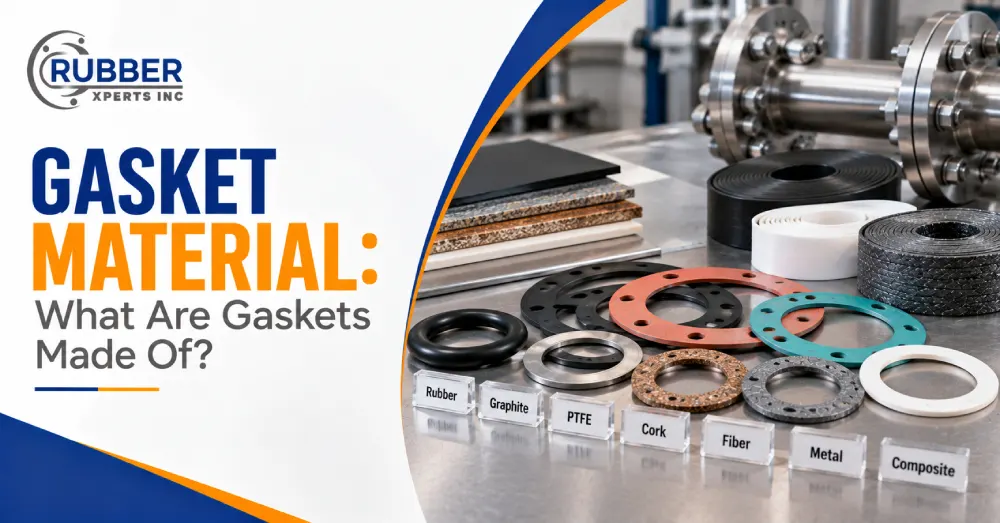
Gaskets are typically made from rubber, graphite, PTFE, cork, compressed fiber, metal, and composite materials. Each gasket material has different properties that determine how well it performs under specific temperatures, pressures, chemical exposures, and mechanical conditions.
Knowing gasket material helps you choose one that will maintain a reliable seal throughout its intended service life. A rubber gasket provides the flexibility needed for certain applications, while graphite or metallic materials may be better suited to higher-temperature or more demanding environments.
The right gasket material varies between industries, as automotive, chemical processing, plumbing, food, pharmaceutical, and industrial applications have different sealing requirements.
What Is a Gasket and What Is Its Primary Function?
A gasket is a sealing component installed between two mating surfaces to prevent fluids or gases from passing through the joint. When the connection is tightened, the gasket is compressed between the surfaces and conforms to minor irregularities that could otherwise create leakage paths.
Gaskets are manufactured from different materials because no single material can withstand every operating condition. The gasket must have suitable resistance to the application’s temperature, pressure, chemicals, and mechanical stresses.
Gasket material is directly connected to sealing performance; what works well for a water connection may not be suitable for high-temperature steam, aggressive chemicals, or an automotive engine.
What Are the Most Common Types of Gasket Materials?
The most common types of gasket materials are listed below.
- Rubber: Rubber and elastomeric materials provide flexibility and compressibility and are commonly used where the gasket must conform closely to mating surfaces. Different rubber compounds provide different levels of resistance to oils, chemicals, heat, weathering, and other conditions.
- Graphite: Graphite has high-temperature resistance and is used in applications where conventional elastomers may not survive the operating environment.
- PTFE: PTFE offers excellent chemical resistance and is commonly selected for applications involving aggressive chemicals and other demanding media.
- Cork: Cork is compressible and can provide effective sealing in suitable low-pressure applications, including certain automotive and equipment applications.
- Compressed fiber: Fiber-based gasket materials combine reinforcing fibers with a binding material to provide a balance of compressibility, strength, and resistance for various industrial applications.
- Metal: Metal gaskets can provide high strength and are used in demanding pressure and temperature environments. Their design and installation requirements vary according to the application.
- Composite: Composite gasket products are made from two or more materials to provide a combination of sealing properties, such as strength, flexibility, temperature resistance, and chemical resistance.
What Makes a Gasket Material Safe?
A gasket material is considered safe and compliant when it meets the standards and regulatory requirements for its intended application. Requirements vary depending on the gasket’s construction as a safe gasket material, the medium being sealed, operating conditions, and whether the gasket comes into contact with food, drinking water, or other regulated substances.
The key factors that make a gasket material safe are listed below.
- Chemical compatibility: The material should resist the fluids, gases, chemicals, oils, fuels, or other media it contacts without swelling, cracking, softening, hardening, or deterioration.
- Temperature resistance: The material must maintain its physical and sealing properties within the application’s normal and maximum temperature range.
- Pressure capability: The gasket material and construction must withstand the system pressure without excessive deformation, extrusion, rupture, or loss of sealing.
- Application suitability: Materials used in food processing, pharmaceutical equipment, or potable-water systems may require specific formulations and regulatory approvals because the gasket can come into contact with the product or water.
- Material certification and compliance: Where regulations or industry standards apply, verify that the specific gasket product and formulation, not merely the general material type, meets the required standards or certifications.
- Manufacturer specifications: The final material choice should be based on the gasket manufacturer’s technical data and the actual operating conditions rather than assuming that a commonly used material is suitable for every application.
Are Flanges and Gaskets the Same Thing?
No. A flange and a gasket are different components that often work together to create a sealed connection.
A flange is a structural connection or mating surface used to join pipes, equipment, or other components. A gasket is the sealing element placed between the flange faces.
Applying clamping force to the joint compresses the gasket between the two surfaces when the flange bolts are tightened. The compressed gasket fills surface irregularities and helps prevent gas or fluids from escaping.
A flange gasket is a gasket designed specifically for use with a flange connection. Its material and construction must be compatible with the pressure, temperature, fluid, and flange design.
What Are the Key Properties of Gasket Materials?
The key properties of gasket materials are listed below.
- Temperature resistance: Determines whether the material maintains its sealing properties at the application’s operating and peak temperatures.
- Pressure resistance: Determines whether the gasket withstands system pressure without losing its seal, extruding, or becoming damaged.
- Chemical resistance: Determines how well the material withstands contact with the fluid, gas, oil, fuel, or chemical being sealed.
- Compressibility: Allows the gasket to conform to surface irregularities and create contact between the mating surfaces.
- Hardness: Affects how readily the material deforms under compression and how well it conforms to the sealing surfaces.
- Flexibility: Helps a gasket conform to surfaces and accommodate certain changes in the joint without losing its seal.
- Durability: Determines how well the gasket maintains its sealing performance throughout its expected service life.
- Aging resistance: Indicates how well the material withstands degradation caused by heat, oxidation, environmental exposure, or prolonged service.
How Do You Select the Best Gasket Material for Your Application?
To select the best gasket material for your application, follow the steps below.
- Identify the media: Determine whether the gasket will contact water, oil, fuel, steam, chemicals, gases, or another substance.
- Determine the operating temperature: Consider both normal and maximum temperatures.
- Determine the operating pressure: Make sure the material and gasket construction can withstand the required pressure.
- Check chemical compatibility: Verify that the material will not swell, degrade, harden, or otherwise deteriorate when exposed to the media.
- Consider the joint design: Examine the mating surfaces, flange configuration, available compression, and required gasket dimensions.
- Consider material properties: Evaluate compressibility, hardness, flexibility, durability, and temperature resistance.
- Consider the environment: Account for moisture, weathering, vibration, movement, and other external conditions where applicable.
- Check application requirements: Follow equipment specifications and relevant industry standards when selecting the gasket.