

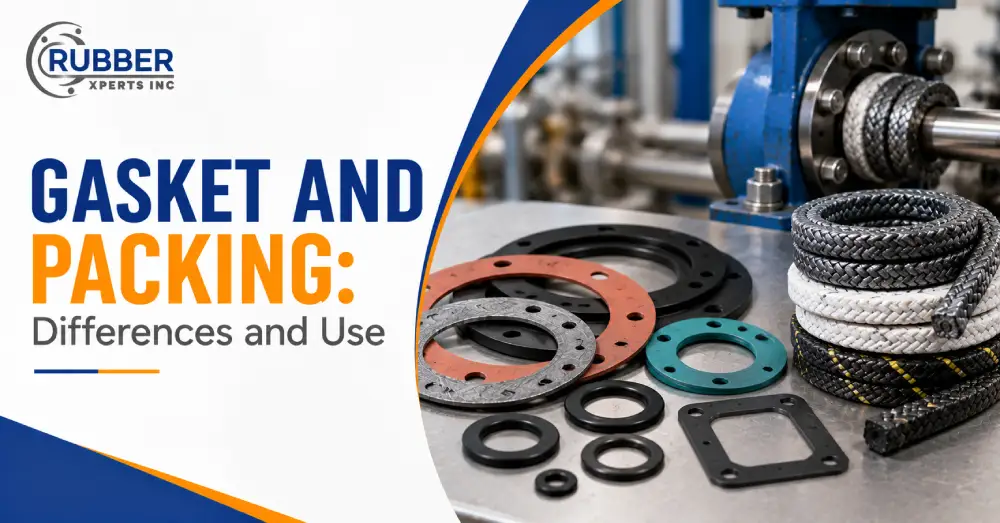
Gaskets and packing are designed for different sealing conditions. Gaskets are mainly used to seal stationary surfaces, while packing is commonly used to seal around moving components such as shafts and valve stems.
Choosing the right sealing method helps prevent leaks, maintain equipment performance, and reduce premature seal failure. The correct choice between rubber gaskets or packing seals depends on the connection design, movement, pressure, temperature, fluid, and maintenance requirements.
What Is the Main Difference Between a Gasket and Packing?
The main difference is where and how they create a seal. A gasket is compressed between two stationary mating surfaces, while packing is compressed around a moving component to control leakage while allowing movement.
Gaskets are commonly installed between flanges, covers, or other fixed connections. Tightening the connection compresses the gasket and closes potential leakage paths between the surfaces.
Packing is commonly installed around valve stems, pump shafts, and other moving components. Compression pushes the packing against the moving component and surrounding housing to restrict fluid leakage.
| Factor | Gasket | Packing |
|---|---|---|
| Primary function | Seals between stationary surfaces | Seals around moving components |
| Sealing type | Mainly static | Commonly dynamic |
| Installation | Between mating surfaces | Around a shaft, stem, or similar component |
| Compression | Created by fasteners or clamping force | Created within a packing chamber or stuffing box |
| Common applications | Flanges, covers, pipe connections | Valves, pumps, shafts |
| Maintenance | Usually replaced after failure or removal | May be adjusted before replacement |
How Do Gaskets Work to Create a Static Seal?
A gasket creates a static seal by sitting between two mating surfaces and being compressed when the connection is tightened.
A rubber seal can be positioned between two pipe flanges, for example. As the flange bolts are tightened, the rubber seal is compressed against both surfaces. The compression allows the rubber seal to conform to small surface irregularities that could otherwise create leakage paths.
The gasket maintains sufficient contact pressure to prevent fluids or gases from passing through the joint. The gasket’s sealing performance therefore depends on factors such as gasket material, compression, surface condition, pressure, temperature, and chemical compatibility.
The gasket can focus on maintaining a stable barrier rather than accommodating continuous movement because the sealed surfaces are normally stationary relative to each other.
What Is Packing Sealing and How Does It Work in Dynamic Systems?
Packing is a sealing material that is compressed around a shaft, valve stem, or another component that moves during operation.
A packing seal is placed inside a stuffing box or packing chamber around the stem or shaft in a typical valve or pump. A gland or compression mechanism applies pressure to the packing, causing it to expand against the surrounding housing and the moving component, which creates a controlled seal that restricts fluid leakage while still allowing the shaft or stem to move.
Proper compression is important because under-compressing allows leakage, while over-compressing increases friction, heat, and wear. Packing performance depends on the condition of the shaft or stem, the packing material, operating temperature, pressure, and the fluid being sealed.
What Are the Main Types and Materials Used for Gaskets and Packing?
Listed below are the main types of materials used for gaskets and packing.
Common gasket materials and types include:
- Rubber gaskets: Used for applications requiring flexibility and compatibility with particular fluids or environmental conditions.
- Compressed fiber gaskets: Used for a range of industrial sealing applications where compressibility and mechanical strength are required.
- Graphite gaskets: Used in applications requiring resistance to elevated temperatures and certain chemicals.
- PTFE gaskets: Selected for applications where broad chemical resistance is important.
- Metal gaskets: Used where high pressure, high temperature, or specialized sealing performance is required.
- Composite and spiral-wound gaskets: Combine different materials or layers to achieve specific sealing characteristics.
Common packing materials and constructions include:
- Graphite packing: Used for applications involving elevated temperatures and certain chemical environments.
- PTFE packing: Selected for chemical resistance and low-friction performance.
- Aramid packing: Provides mechanical strength and resistance to abrasion in suitable applications.
- Braided fiber packing: Uses woven or braided fibers to create a flexible sealing material for pumps, valves, and other equipment.
How Does Packing Differ From O-Rings and Other Seals?
Packing, O-rings, and mechanical seals all control leakage, but they use different sealing designs.
Packing is compressed around a shaft or stem and can accommodate controlled movement, which is commonly used in valves and pumps.
O-rings are elastomeric seals installed into specially designed grooves, which create a seal through compression between the rubber O-ring and its mating surfaces. O-rings can be used for both static and certain dynamic applications depending on the design.
Mechanical seals are engineered sealing assemblies commonly used around rotating shafts. They use precisely machined sealing faces and other components to control leakage during rotation.
The appropriate seal depends on the equipment design, movement, pressure, temperature, fluid, and maintenance requirements, as it is not simply a substitute for another type of seal.
When Should You Use a Gasket Versus Packing?
Listed below are the factors for when to use a gasket over packing.
- Use a gasket for stationary joints: Gaskets are appropriate for flanges, pipe connections, covers, and other fixed mating surfaces where compression creates the seal.
- Use packing for moving components: Packing is commonly used around valve stems, pump shafts, and similar components that rotate, reciprocate, or move during operation.
- Consider pressure and temperature: Choose a gasket or packing material that can withstand the system’s operating pressure and temperature without losing its sealing properties.
- Consider the media: The sealing material must be compatible with the fluid, gas, oil, chemical, or other medium being contained.
- Consider movement: Determine whether the sealing surfaces remain stationary or whether a shaft or stem moves through the seal during operation.
- Consider maintenance requirements: Gaskets are generally replaced when a joint is opened or the gasket fails, while packing may be adjustable to control leakage before replacement is necessary.
- Consider installation requirements: Gaskets require suitable mating surfaces and proper compression, while packing requires correct installation and controlled compression around the moving component.
- Follow equipment specifications: The manufacturer’s requirements should determine the appropriate sealing method and material for the specific application.
Can a Gasket Be Used Instead of Packing?
No, a conventional gasket is designed to seal between stationary joint surfaces and is not conventionally designed to accommodate continuous shaft or stem movement.
Installing a gasket around a moving component can result in inadequate contact, excessive wear, or leakage. The sealing system should use the type of packing or dynamic seal specified for that application if the equipment requires sealing around a moving shaft or valve stem.
A gasket can be appropriate when the connection is completely stationary and its design provides suitable mating surfaces for gasket compression.
Can Packing Be Used Instead of a Gasket?
No, packing cannot be used for conventional flange and stationary joint connections.
Packing is designed to seal around a component, typically within a packing chamber or stuffing box, normally providing the same broad, compressed sealing interface required between two stationary flanges or equipment surfaces.
Replacing a specified gasket with packing creates an improper sealing arrangement and increases the risk of leakage.
Can Gaskets and Packing Be Used Together?
Yes. Gaskets and packing can be used together when equipment contains both stationary and dynamic sealing surfaces.
A pump may use a gasket to seal a stationary housing connection while using packing around a shaft or another component where controlled movement occurs.
The two sealing products perform different functions. The gasket handles the static joint, while the packing handles the dynamic sealing point.
What Causes a Gasket to Fail?
The causes that make a gasket fail are listed below.
- Insufficient or uneven compression: The gasket may not maintain enough contact pressure to prevent leakage.
- Incorrect gasket selection: The material or construction may not be compatible with the operating conditions.
- Damaged mating surfaces: Scratches, corrosion, warping, or surface irregularities can create leakage paths.
- Excessive pressure or temperature: Operating beyond the gasket’s capabilities can cause degradation or loss of sealing performance.
- Chemical incompatibility: The sealed fluid can attack or deteriorate the gasket material.
- Improper installation: Incorrect alignment, torque, tightening sequence, or surface preparation can compromise the seal.
- Fastener problems: Incorrect or uneven clamping force can prevent the gasket from sealing properly.
What Causes Packing to Leak or Wear Out?
The causes that make a packing leak are listed below.
- Insufficient compression: Packing may not maintain enough contact with the shaft or housing to control leakage.
- Excessive compression: Too much compression can increase friction, heat, and wear.
- Shaft or stem movement: Excessive movement, vibration, or misalignment can accelerate packing wear.
- Damaged surfaces: A worn, rough, scored, or corroded shaft or stem can damage the packing and create leakage paths.
- Incorrect packing material: The material may not withstand the operating temperature, pressure, or chemical environment.
- Heat and chemical exposure: Conditions beyond the packing’s capabilities can cause deterioration.
- Improper installation: Incorrect packing installation or compression can shorten service life.
How Do You Know When a Gasket or Packing Needs to Be Replaced?
The things to know when you need a gasket or packing.
- Visible fluid or gas leakage
- Persistent seepage after tightening or adjustment
- Cracks, splits, or tears in the sealing material
- Hardening, brittleness, or loss of flexibility
- Flattening, deformation, or extrusion
- Packing that remains loose or leaks despite proper adjustment
- Excessive packing wear around a shaft or valve stem
- Repeated sealing failure after installation
- Corrosion or damage around the sealing area
- Loss of compression or sealing pressure
- Unusual equipment performance caused by continued leakage
- A gasket or packing that has been removed and is not approved for reuse by the manufacturer
Can the Same Gasket or Packing Material Be Used for Every Application?
No, there is no universal gasket or packing material suitable for every application.
Different sealing materials respond differently to temperature, pressure, chemicals, fluids, movement, and mechanical loads. Materials that perform well in a low-temperature water application may not be suitable for high-temperature steam, aggressive chemicals, or continuous shaft movement.
Gasket selection depends on the fluid, pressure, temperature, flange design, and required compression. Packing selection must additionally account for movement, shaft or stem condition, friction, and the type of equipment being sealed.