

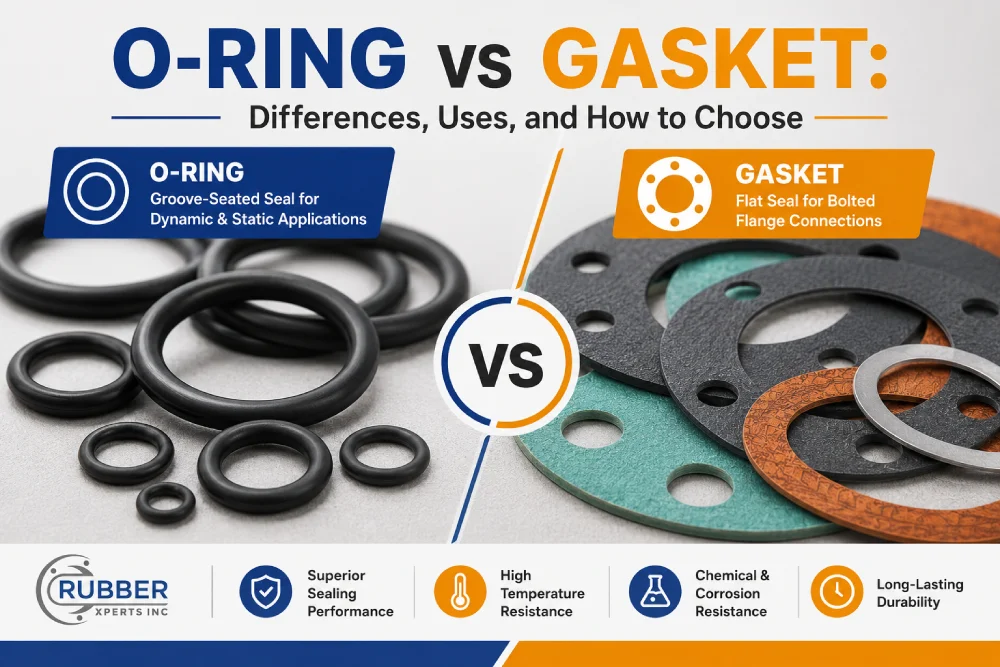
O-rings and gaskets are two of the most used sealing components in U.S. industrial, automotive, hydraulic, and process piping systems, differing in shape, sealing method, groove requirement, and application.
Gaskets are flat or sheet-form elements compressed between bolted mating surfaces at pipe flanges, cylinder heads, and valve bodies, while O-rings are toroidal elastomeric seals seated within grooves in hydraulic cylinders, pumps, and pneumatic actuators. Material selection includes rubber, PTFE, graphite, metal, Nitrile, FKM, and EPDM, each rated for temperature ranges, pressure classes, and chemical compatibility.
Choose a gasket for stationary bolted flat-face joints requiring full-face coverage, and an O-ring for groove-seated interfaces involving static or dynamic pressure containment.
What Is a Gasket?
A gasket is a compressible sealing component installed between two mating surfaces to prevent leakage of fluids, gases, or pressure. A gasket aligns to surface irregularities under bolt load, creating a static seal at the interface.
Common forms include sheet, spiral-wound, ring-type, and full-face configurations, made from PTFE, compressed fiber, graphite, and metal. The rubber gaskets are applied in pipe flanges, cylinder heads, heat exchangers, and pressure vessel joints to maintain a leak-proof static seal under mechanical compression and varying operating pressures.
How Does a Gasket Work?
A gasket works by being compressed between two mating surfaces. The compression allows the gasket material to conform to small surface imperfections, scratches, and uneven areas, creating a tight seal that blocks the passage of fluids or gases.
The seal helps maintain system pressure and prevents leakage during operation.
What Are Gaskets Used For?
The common applications of gaskets are listed below.
- Pipe Flanges: Gaskets seal the mating faces of flanged pipe joints to prevent process fluid or gas leakage under line pressure.
- Pressurized Pipe Connections: Gaskets seal union fittings and threaded pipe connections to prevent fluid bypass in pressurized pipeline systems.
- Engine Cylinder Heads: Head gaskets seal the combustion chamber between the engine block and cylinder head to contain compression, oil, and coolant flow.
- Centrifugal Pumps: Gaskets seal casing joints and stuffing box covers to contain pressurized fluid within the pump housing.
- Plumbing Fixtures: Gaskets seal valve bodies, shut-off valves, and fixture connections to prevent water leakage at flat-face or threaded interfaces.
- Industrial Equipment: Gaskets seal heat exchangers, pressure vessels, and reactor flanges to isolate process media under rated operating conditions.
What Are the Different Types of Gaskets?
The different types of gaskets are listed below.
- Flat Gaskets: Sheet-cut sealing components installed between mating surfaces to block fluid or gas leakage under uniform bolt load.
- Flange Gaskets: Sealing elements fitted between raised-face or flat-face pipe flanges to contain pressurized process media at bolted joint interfaces.
- Rubber Gaskets: Elastomeric sealing components that compress between mating surfaces to seal fluids and gases in low-to-medium pressure applications.
- Spiral-Wound Gaskets: Alternating metal and filler strips wound concentrically to seal high-pressure, high-temperature flanged joints.
- Metal Gaskets: Solid or jacketed metallic sealing elements rated for extreme pressure and temperature service where soft materials fail.
- Cork Gaskets: Compressible sealing components cut from cork composite sheets, used in low-pressure oil, fuel, and solvent service.
- PTFE Gaskets: Inert sealing elements used in corrosive media service in wide temperature ranges in process piping systems.
- Foam Gaskets: Closed-cell or open-cell sealing components used in low-pressure enclosures to block dust, moisture, and air ingress.
What Materials Are Gaskets Made From?
The materials that gaskets are made from include rubber compounds (EPDM, Nitrile, Neoprene), PTFE, compressed fiber, graphite, spiral-wound metal, cork composite, foam, and solid metal variants (soft iron, stainless steel, and copper).
Material selection depends on operating temperature ranges from -328°F for PTFE to 5,400°F for graphite in non-oxidizing service, with system pressure ratings, chemical compatibility, and flange face finish. Corrosive media service requires PTFE or graphite, high-pressure Class 2500 joints demand spiral-wound or RTJ metal gaskets, and low-pressure fluid applications accept rubber or fiber sheet materials.
What Is an O-Ring?
An O-ring is a circular elastomeric seal with a toroidal cross-section, seated within a groove to create a pressure-tight interface between mating surfaces. O-rings function as a primary sealing element in hydraulic, pneumatic, and fluid systems rated for pressures up to 5,000 PSI without backup rings.
Manufactured from elastomers including Nitrile, EPDM, Viton, and Silicone, rubber O-rings are specified in plumbing, aerospace, automotive, and industrial equipment based on media compatibility and temperature range.
How Does an O-Ring Work?
An O-ring works through diametric compression against groove walls and mating surfaces, causing the elastomeric cross-section to deform and fill surface gaps that allow fluid or gas bypass. System pressure energizes the seal by pushing the O-ring against the low-pressure groove wall, which increases contact stress as pressure rises.
Proper groove dimensioning maintains an 8%-30% crush range, providing enough sealing force while limiting extrusion, excessive friction, and compression set.
What Are O-Rings Used For?
O-rings are used in static and dynamic sealing applications in plumbing, hydraulics, automotive, aerospace, machinery, and industrial equipment. In plumbing systems, they seal valves, threaded fittings, faucets, and pipe connections against fluid leakage, while hydraulic systems use them in cylinders, pumps, and valves to retain pressurized fluid.
Automotive and aerospace systems use O-rings in fuel injectors, coolant lines, hydraulic actuators, and pneumatic components, while machinery and industrial equipment use them in pumps, compressors, shafts, valves, and other fluid-handling components.
What Are the Different Types of O-Rings?
The different types of O-rings are listed below.
- Buna-N (Nitrile) O-Rings: Nitrile seals rated for petroleum-based oils, fuels, and hydraulic fluids between -40°F and 250°F.
- EPDM O-Rings: Ethylene propylene diene monomer seals specified for water, steam, and brake fluid service between -65°F and 300°F.
- Silicone O-Rings: High-purity seals rated from -100°F to 450°F for food-grade, medical, and high-temperature pneumatic applications.
- FKM (Viton) O-Rings: Fluoroelastomer seals rated up to 400°F with superior resistance to fuels, acids, and aggressive chemicals.
- HNBR O-Rings: Hydrogenated nitrile seals rated between -40°F and 300°F for refrigerant, oilfield, and automotive systems.
- PTFE O-Rings: Chemically inert thermoplastic seals rated from -328°F to 500°F for corrosive media service where elastomers fail.
- Neoprene O-Rings: Polychloroprene seals rated between -65°F and 250°F for refrigerants, ammonia, and moderate oil service in HVAC and marine applications.
What Materials Are O-Rings Made From?
O-rings are made from elastomeric and thermoplastic compounds including Nitrile (Buna-N), EPDM, Silicone, FKM (Viton), HNBR, Neoprene, and PTFE, each selected based on media compatibility, temperature rating, and mechanical demands. Nitrile handles petroleum oils and fuels between -40°F and 250°F.
EPDM resists water, steam, and outdoor weathering up to 300°F with superior ozone and UV degradation resistance. Silicone performs from -100°F to 450°F in food-grade and pneumatic service, and FKM withstands aggressive chemicals and fuels up to 400°F. HNBR covers refrigerant and oilfield service up to 300°F, Neoprene suits HVAC and marine refrigerant systems with moderate weather resistance, and PTFE handles corrosive media in -328°F to 500°F where standard elastomers degrade.
When Should You Use a Gasket?
Use a gasket when stationary, bolted joints such as pipe flanges, cylinder heads, valve bodies, or heat exchanger covers require static sealing. Gaskets are preferred for wide, irregular, or unmachined sealing surfaces where O-ring grooves are impractical, but unsuitable for rotary or reciprocating motion, where O-rings or mechanical seals are more appropriate.
Material selection depends on temperature, pressure, chemical compatibility, fluid type, and flange design. Choose a gasket when a stationary bolted joint requires full-face sealing.
When to Choose a Flat Gasket
Choose a flat gasket when sealing raised-face or flat-face flanged joints in piping, heat exchangers, and valve bodies requiring full-face static coverage under uniform bolt load. Low-to-medium pressure, low-surface-finish flange applications below 700°F favor sheet-cut PTFE, compressed fiber, and rubber as sheet materials.
The flat gasket is appropriate for low-to-medium pressure joints. Spiral-wound or RTJ metal gaskets are the appropriate specification instead for Class 900 and above. The selection factors include operating temperature and pressure class.
A flat gasket is the right call when the joint is stationary, bolted, flat-faced, and rated below Class 300 service conditions.
When to Choose a Rubber Gasket
Choose a rubber gasket when sealing low-to-medium pressure plumbing fixtures, pipe unions, and flanged joints handling water, steam, petroleum fluids, and mild chemicals. High compressibility favors rubber over rigid PTFE or metallic types in low-torque, uneven, or lightly finished flange faces. It falls short in high-temperature steam above 300°F or aggressive chemical service, and PTFE or graphite are more appropriate there.
Key selection factors are fluid type, temperature rating, and chemical compatibility. Go with rubber when the joint is low-pressure and needs a compressible elastomeric seal.
When to Use a Flange Gasket
Use a flange gasket when sealing bolted pipe flange connections in process piping, water treatment, and industrial systems requiring full-face static coverage in raised-face, flat-face, or ring-type joint flange configurations.
Spiral-wound and PTFE flange types suit ASME Class 150 to Class 2500 pressure ratings, with material selection driven by operating temperature, pressure class, and process media compatibility. The flange gaskets provide the pressure-tight, full-face sealing integrity that groove-seated O-rings do not achieve in interfaces.
When a Gasket Is Better Than an O-Ring
A gasket is better than an O-ring when the sealing interface is wide and flat (pipe flanges, cylinder heads, heat exchangers), where groove machining for O-ring seating is impractical.
Gaskets handle full-face coverage on irregular surfaces under distributed bolt load, while O-rings are limited to geometries with tight dimensional tolerances. Select a gasket over an O-ring when the joint is stationary, bolted, wide-bore, and requires sealing against high-pressure or aggressive media.
When Should You Use an O-Ring?
Use an O-ring when sealing groove interfaces in hydraulic cylinders, pneumatic actuators, pumps, and valve stems requiring compact, reliable static or dynamic sealing. O-rings are favored in applications where installation space is limited, groove geometry is machinable, and system pressure energizes the seal against groove walls for leak-free performance.
Specify an O-ring when the joint involves rotary or oscillating motion, conditions where gaskets fail due to lack of dynamic sealing capability.
When to Choose an O-Ring Seal
Choose an O-ring seal when it involves groove interfaces in hydraulic, pneumatic, or fluid power systems requiring static or dynamic pressure containment. O-ring seals outperform flat gaskets in compact, high-pressure assemblies where groove geometry controls crush percentage and sealing force with precision.
Go with an O-ring seal when space constraints and dynamic motion design make full-face gasket installation impractical.
When to Use an O-Ring Instead of a Gasket
Use an O-ring instead of a gasket when the sealing interface is subject to dynamic motion. O-rings handle reciprocating rod seals, rotary shaft seals, and static face seals in hydraulic and pneumatic systems where gaskets would extrude, creep, or fail under cyclic pressure loading.
Switch to an O-ring when the assembly involves a groove, dynamic movement, or compact bore where a gasket’s full-face format is incompatible.
Common Applications for O-Rings
The common applications of O-rings are listed below.
- Hydraulic Systems: Seal cylinder bores, piston rods, and valve spools under high-pressure fluid power conditions.
- Centrifugal Pumps: Seal casing joints and shaft sleeves to contain pressurized fluid within pump housings.
- Valves: Seal stem packings, bonnet joints, and seat interfaces in ball, gate, and needle valves.
- Plumbing Fixtures: O-rings seal faucet cartridges, shut-off valve stems, and pipe union faces at low-pressure water connections.
- Automotive Systems: Seal fuel injectors, power steering lines, A/C fittings, and engine oil passages.
- Pneumatic Actuators: Seal piston and rod interfaces in pneumatic cylinders across reciprocating motion service.
- Industrial Machinery: Seal gearbox covers, compressor heads, and bearing housings in rotating equipment applications.
- Aerospace Systems: Seal hydraulic actuators, fuel fittings, and pneumatic lines rated for extreme temperature and pressure conditions.
How to Choose the Right Gasket?
To choose the right gasket, follow the six steps listed below.
- Identify the Flange or Joint Type. Determine if the sealing surface is raised-face, flat-face, or RTJ to narrow compatible gasket configurations.
- Check Pressure and Temperature Ratings. Match material to ASME pressure class (compressed fiber below 700°F, spiral-wound for Class 900 and above).
- Assess Chemical Compatibility. Specify PTFE for acids, rubber for water and petroleum, and graphite for high-temperature oxidizing media.
- Evaluate Flange Face Finish. Confirm surface roughness (Ra) matches the gasket type, because rubber suits low Ra, and spiral-wound requires serrated finishes.
- Confirm Static Application. Verify the joint has no dynamic motion, as gaskets are unsuitable for reciprocating or rotary interfaces.
- Match Dimensions to Bolt Pattern. Size gasket OD, ID, and bolt holes per ASME B16.20 or B16.21 standards.
How to Choose the Right O-Ring?
To choose the right O-ring, follow the six steps listed below.
- Measure the Groove Dimensions. Determine groove ID, width, and depth per AS568 or metric standard sizing.
- Identify Static or Dynamic Service. Specify 70-90 Shore A for dynamic applications and a softer durometer for static face seals.
- Match Elastomer to Process Media. Select Nitrile for petroleum, EPDM for water and steam, FKM for chemicals, and Silicone for high-temperature pneumatic service.
- Verify Temperature Range. Confirm the elastomer covers operating extremes. FKM up to 400°F, Silicone up to 450°F, PTFE up to 500°F.
- Check System Pressure Rating. Specify back-up rings for dynamic applications exceeding 1,500 PSI to prevent extrusion.
- Confirm Chemical Compatibility. Cross-reference elastomer against fluid media charts to rule out swelling or degradation.
Are Gaskets and O-Rings the Same Thing?
No, gaskets and O-rings are not the same thing. Both are sealing components, but gaskets are flat or sheet-form elements installed between bolted mating surfaces.
O-rings are toroidal elastomeric seals seated in grooves, differing in shape, installation method, and application.
Is an O-Ring a Type of Gasket?
No, an O-ring is not a type of gasket. O-rings are classified as elastomeric seals, while conventional gaskets are flat or sheet-form sealing elements compressed between bolted mating surfaces without groove seating.
O-rings and gaskets differ in geometry, installation method, and sealing mechanism, despite serving a similar leak-prevention purpose.
Can an O-Ring Replace a Gasket?
No, an O-ring cannot replace a gasket in most applications. Replacement is only feasible when the mating surfaces are precision-machined, and the system pressure, temperature, and media compatibility fall within the O-ring’s rated service conditions.
An O-ring in a flat-face flanged joint without a machined groove results in poor compression, extrusion, and sealing failure.
Can a Gasket Replace an O-Ring?
No, a gasket cannot replace an O-ring in a groove interface. Flat gaskets lack the toroidal cross-section required to fill and pressurize within a machined groove, resulting in insufficient contact stress, bypass leakage, and mechanical instability under system pressure.
Replacing an O-ring with a gasket requires a complete redesign of the sealing arrangement, converting the groove interface to a flat-face bolted joint compatible with sealing elements.
What Is the Difference Between a Gasket and a Seal?
A gasket is a flat or sheet-form sealing component compressed between bolted mating surfaces, while a seal is the broader category covering all sealing elements in static and dynamic interfaces.
Gaskets and O-rings are sealing components. It used in flat-face bolted joint configurations, and O-rings are seated within grooves in hydraulic, pneumatic, and fluid system assemblies.
How Long Do Gaskets and O-Rings Last?
Gaskets and O-rings last from 1 to 5 years for elastomeric types, up to 10 years for PTFE and compressed fiber, and over 20 years for metal gaskets under rated conditions.
Service life depends on operating temperature, system pressure, chemical exposure, compression set, and installation quality. Selecting the compound based on manufacturing materials relative to fluid compatibility and thermal cycling range is the critical factor in maximizing seal service life.
What Is the Difference Between a Gasket and Packing?
A gasket is a static sealing component compressed between bolted mating surfaces at joints and valve bodies, while packing is a dynamic sealing material installed around reciprocating or rotary shafts, valve stems, and pump plungers to control leakage under continuous motion.
Both serve fluid and gas containment purposes, but gaskets operate under bolt-load compression, while packing accommodates shaft movement through adjustable gland compression.